

Table of Content
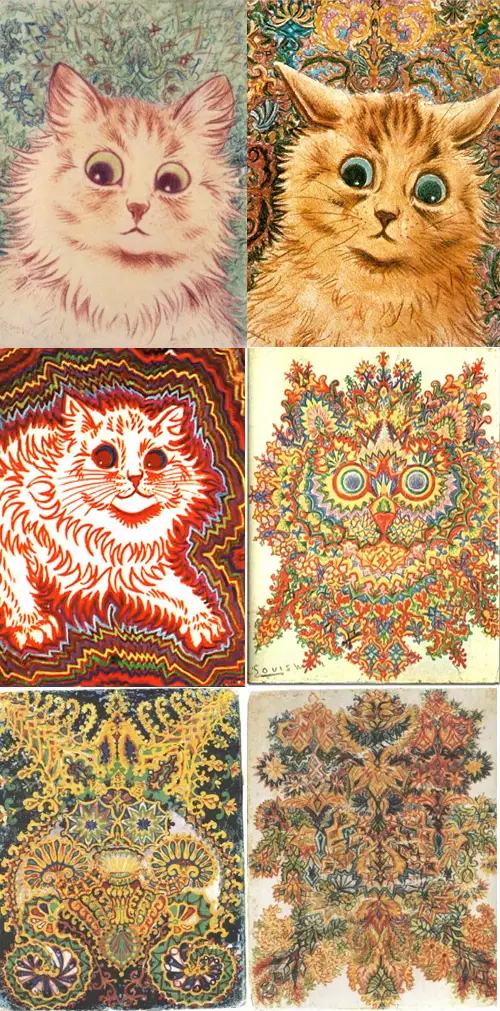
I’ll be honest: I met Louis Wain’s cats long before I knew his name. It was one of those late-night scrolls where you promise yourself “just five more minutes” and an hour quietly disappears. Somewhere between a recipe and a book haul, there they were: a row of cats, each one stranger than the last. The first was a perfectly ordinary tabby. By the end, the cat had turned into something closer to a glowing Persian rug. The caption said this was what an artist’s mind looked like as it fell apart.
I saved it, felt suitably haunted, and moved on. But it kept nagging at me, the way a good mystery does. So, being the curious (read: nosy) reader that I am, I went digging. And it turns out the most famous part of the story is the one part nobody can prove.
The man behind those cats was Louis Wain, once the most famous cat artist in Britain. His life really did include fame, poverty, grief and years in psychiatric hospitals. But that neat little “progression” that made him a textbook example of madness? Someone else put it together, after the fact, from pictures that were never dated. Let me tell you the whole story.
The Kitten That Started It All
Louis Wain was born in Clerkenwell, London, on 5 August 1860, with a cleft lip and, by most accounts, a very busy imagination. His father traded in textiles and his mother, Julie Felicie Boiteux, was a French church embroiderer, so he grew up surrounded by pattern and colour. (Remember that. It matters later.) He was also the only son in a family with five younger sisters, which would shape the rest of his life.
In January 1884 he married Emily Richardson, who had been his sisters’ governess. Sadly, soon after the wedding, Emily was diagnosed with breast cancer. The couple had taken in a black-and-white kitten called Peter, and Wain began drawing him to make Emily smile while she was ill. She was the one who told him to get those drawings published. Every artist needs someone like Emily in their corner.
At Christmas 1886, The Illustrated London News printed his A Kitten’s Christmas Party: around 150 cats across eleven panels, sending invitations, giving speeches and generally behaving like a Victorian dinner party that had gone slightly off the rails. It made his name. Heartbreakingly, Emily died in January 1887, only three years after their wedding, and never got to see what those cats turned into.
Famous Everywhere, Paid Almost Nothing
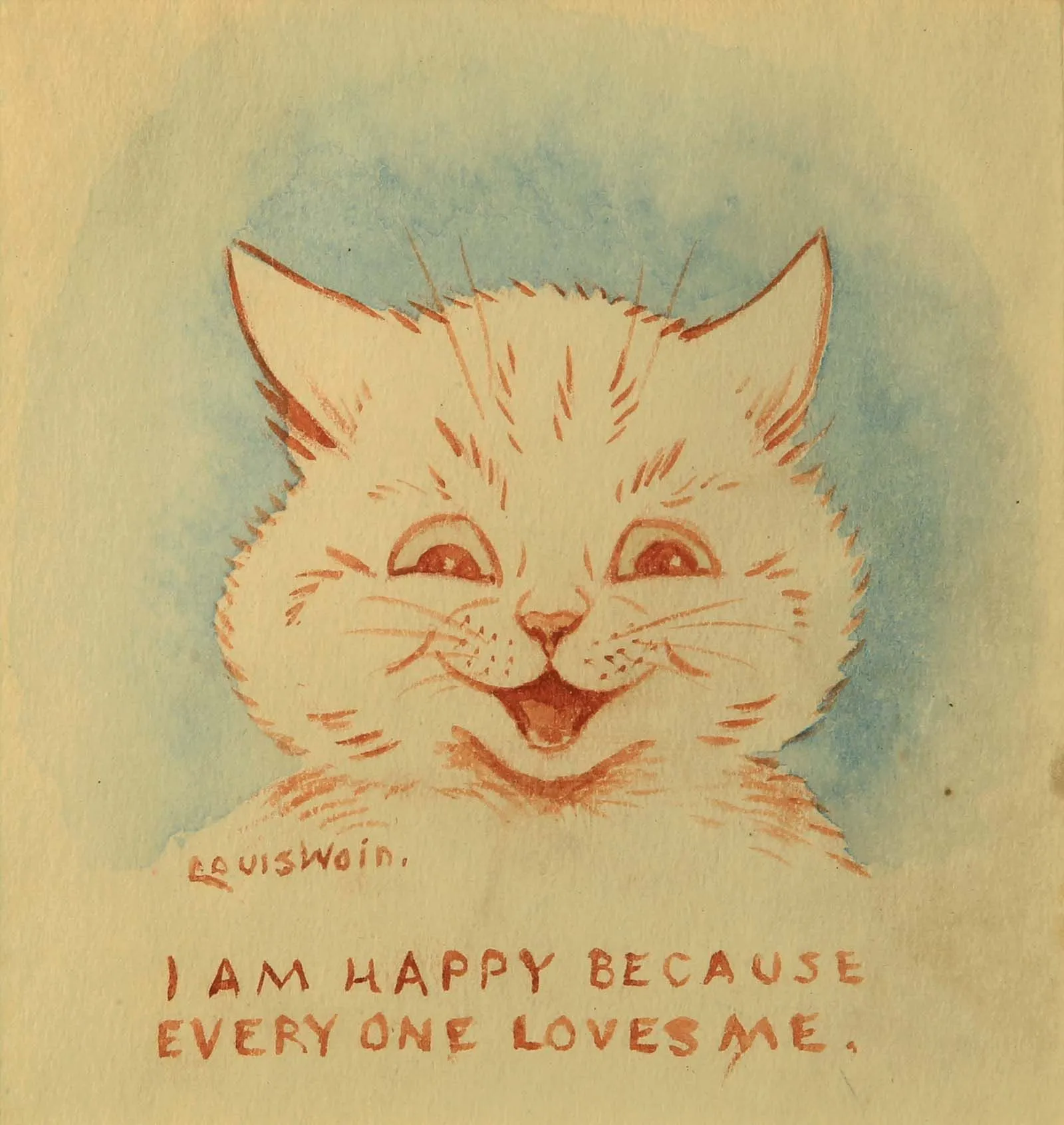
For the next twenty years, Wain’s cats were everywhere: in annuals, magazines, children’s books and on postcards. They stood on two legs, played golf, went to school and threw parties. If Victorian Britain had had Instagram, Louis Wain would have run its biggest cat account. He was even elected president of the National Cat Club, at a time when many people still saw cats as mouse-catchers rather than pets, and he is often credited with helping to make them respectable.
Now for the painful part. Wain never protected the copyright on his pictures. Around 1,100 of his postcards were printed by about 75 different publishers between 1900 and 1940, and not one of them paid him royalties. He was supporting his mother and sisters, he was hopeless with money, and a trip to New York (1907 to 1910) didn’t fix things either. He came home after his mother died.
He was also, to put it kindly, a man with unusual ideas. According to the Spectator, he believed cats tended to face north because of “the electrical strength” of their fur. Electricity fascinated him, which is where the 2021 film about him, starring Benedict Cumberbatch, gets its title: The Electrical Life of Louis Wain.
From the Pauper Ward to the Radio
In October 1914, Wain fell from the platform of a London omnibus, hit his head and spent weeks in hospital. Over the next few years his behaviour became more and more erratic. By the 1920s, according to the Wellcome Collection, he was writing about spirits that filled him with electricity and accusing his sisters of plotting against him.
In June 1924 he was certified insane and admitted to the pauper ward of Springfield Hospital in Tooting. Think about that for a second: the man whose cats hung in nurseries across the country was now a patient almost nobody recognised. Then, in 1925, a bookseller named Dan Rider found him there and started a public appeal, and suddenly the story was national news.
Even H. G. Wells joined in, and a statement from him was read on BBC radio in August 1925. It is still the best description of Wain anyone has written: “He has made the cat his own. He invented a cat style, a cat society, a whole cat world. English cats that do not look and live like Louis Wain cats are ashamed of themselves.”
The money moved Wain to the much kinder Bethlem Royal Hospital, and in May 1930 to Napsbury Hospital in Hertfordshire. He kept drawing and painting almost to the end, and many of those later pictures are sweet, conventional and very much in his old style. Hold on to that detail too.
The Eight Cats That Started a Myth
Now for the famous cats. In 1939, a doctor named Walter Maclay (1902–64) found eight of Wain’s pictures in a junk shop in Notting Hill. Yes, a junk shop. Imagine popping in for a secondhand lamp and walking out with a piece of psychiatric history.
The pictures were dazzling: cats edged with zigzags of colour, cats made of flowers, cats that looked like stained glass. Maclay was interested in how mental illness affects art, so he lined them up in an order that ran from realistic to almost completely abstract.
That order told a very tidy story: the sicker Wain became, the more his cats fell apart. The problem, as the Wellcome Collection puts it, is that “there was no evidence to support this ordering.” The pictures were undated. Wain’s biographer Rodney Dale pointed out that Maclay simply arranged them as a sequence, and that Wain was still painting perfectly ordinary cats years after he was supposed to have lost the ability. (See? I told you that detail mattered.)
So the “progression” tells us more about what doctors in the 1930s expected madness to look like than about how Wain actually worked. A writer for the Bethlem Museum of the Mind, which now looks after the series known as the Kaleidoscope Cats, put it simply: Wain certainly had a breakdown and his work did change, but “it is hard to describe the pictures as deteriorated.”
So Where Did the Patterns Come From?
If the patterns weren’t just a symptom, where did they come from? Nobody knows for sure, but there are some intriguing clues. Remember the textile-trading father and the embroiderer mother? Ornament was practically Wain’s first language. The Spectator also notes that he could mirror-write and draw with both hands at once, and Dale suggested the kaleidoscope pictures may have been him playing with exactly that skill.
Even his diagnosis is less settled than the famous image suggests. He was labelled schizophrenic, but the Bethlem Museum of the Mind says there has been “much debate” about how he might be diagnosed today, and the Wellcome Collection mentions a popular modern theory that he may have been autistic. Some people have also wondered about that 1914 head injury. Honestly, what we really have is a talented man who became very unwell, and a lot of guesswork added later.
So why has the myth lasted so long? I think it is the same impulse that makes us romanticise the suffering behind books like The Bell Jar: we love art that seems to explain the person who made it. And the internet loves a story that is too good to check. It happened with Edward Mordake, the “man with two faces”, whose legend has been doing the rounds since 1895, and it happened with Wain’s cats too.
Are Louis Wain Paintings Worth Anything Today?
Here’s a twist he would have found either hilarious or deeply unfair. The man who earned nothing from 1,100 postcards is now seriously collectable, and original Louis Wain art turns up at auction all the time. At Bonhams in London in November 2024, his painting Spring Cleaning led a Modern British art sale at around $40,000, according to HENI News, while smaller drawings and watercolours regularly sell for a few thousand pounds. Somewhere, I like to think, a cat in a tiny top hat is laughing.
The Kaleidoscope Cats themselves aren’t for sale. They belong to the Bethlem Museum of the Mind, on the grounds of the hospital where Wain spent five years of his life, which feels like exactly the right home for them.
The Kitten Was Himself
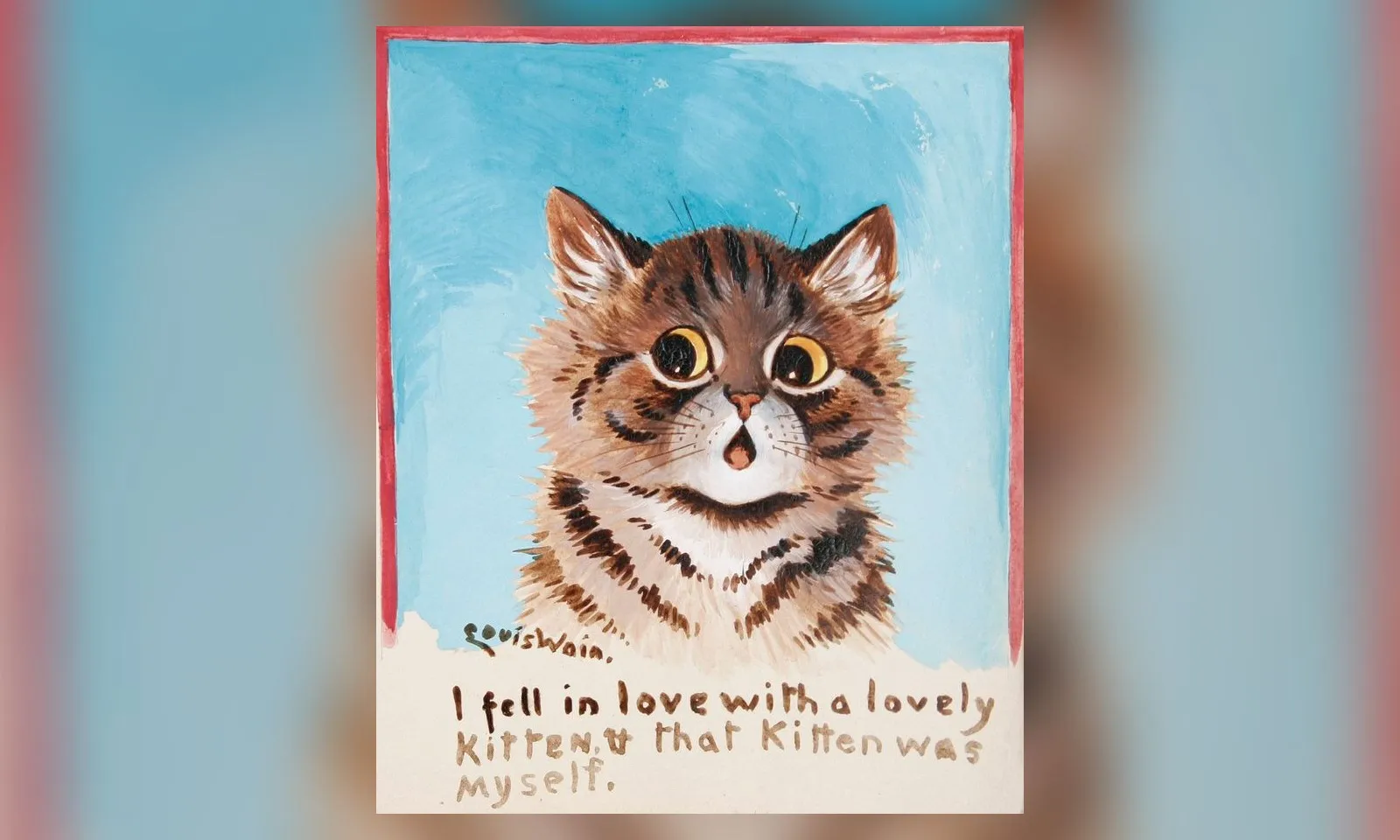
Louis Wain died at Napsbury on 4 July 1939, aged 78, after a stroke in November 1938. In one of his paintings, a wide-eyed tabby looks out above a line written in his own hand: “I fell in love with a lovely kitten & that kitten was myself.”
I can’t think of a better summary. He spent his whole life drawing cats who were really people, with their parties, their pride and their small embarrassments. The strangest thing about Louis Wain isn’t that his cats changed. It’s that, more than a century later, we are still arguing about what they mean.
As for that late-night post that started all this? I still have it saved. I just read the caption very differently now.
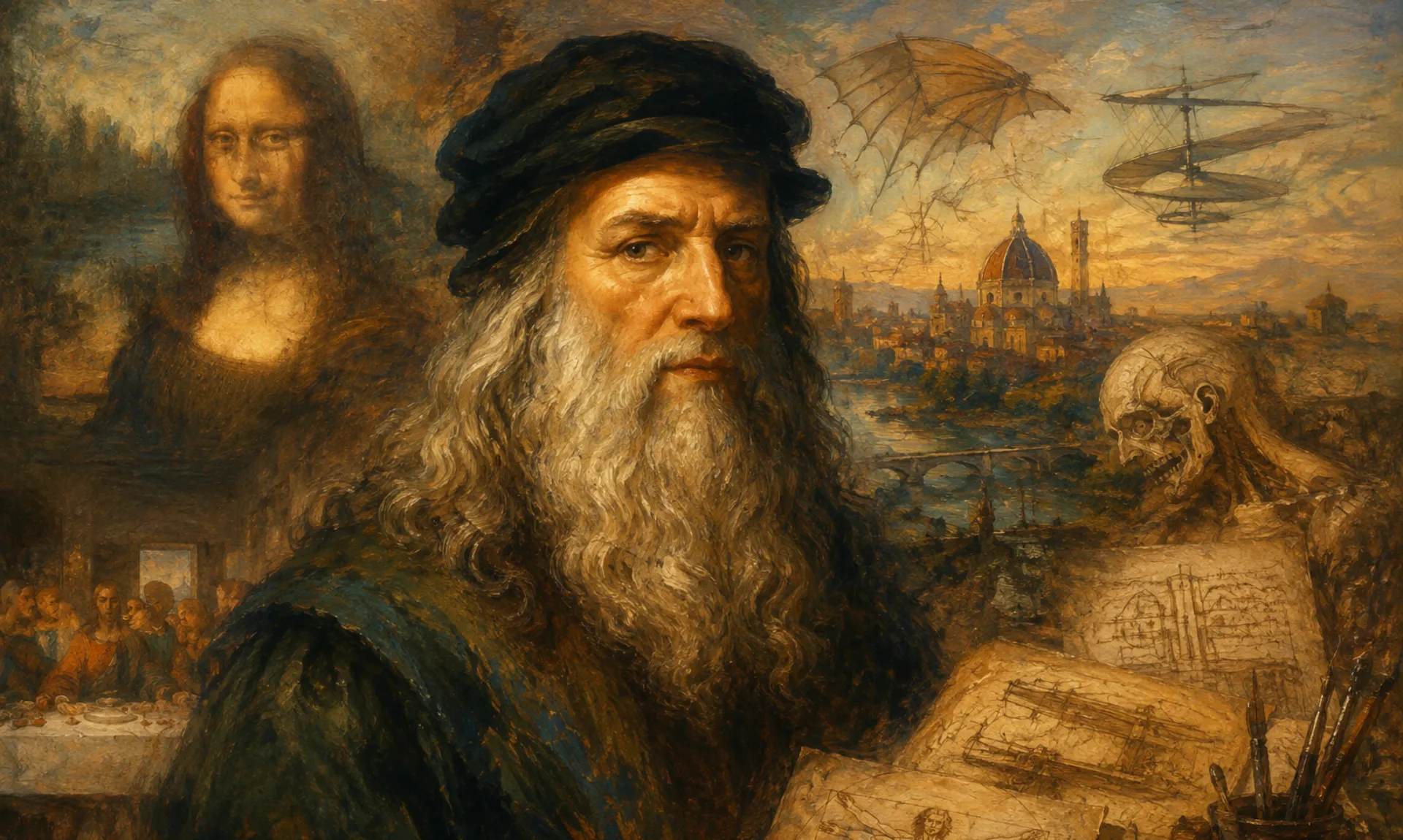
If you enjoyed this little rabbit hole, there are plenty more where it came from. Head over to Info-Bites for more forgotten stories and surprising truths about the people who shaped art and literature. You could start with Mary Shelley, the woman behind Frankenstein, or with Leonardo da Vinci’s restless genius.
Research References
- Wellcome Collection: Louis Wain’s cryptic cats
- Bethlem Museum of the Mind: Two Men and Eight Cats
- Bethlem Museum of the Mind: Kaleidoscope Cats, a clinical perspective
- Mind Hacks: The false progression of Louis Wain
- The Spectator: How crazy was Louis Wain?
- Wikipedia: Louis Wain
- The National Archives: Louis Wain
- HENI News: Bonhams Modern British & Irish Art auction, November 2024
Frequently Asked Questions
What are Louis Wain’s kaleidoscope cats?
They are eight brightly patterned cat pictures by Louis Wain that the doctor Walter Maclay found in a London junk shop in 1939. Maclay arranged them from realistic to abstract, and they are now known as the Kaleidoscope Cats, held by the Bethlem Museum of the Mind.
Did Louis Wain’s cats really get stranger as his illness got worse?
Not in any way that can be proved. The kaleidoscope pictures were undated, the order was chosen later by Maclay, and Wain kept painting conventional cats during his hospital years. Experts now treat the neat progression as a myth.
Are Louis Wain paintings worth anything?
Yes. His work is collected today: smaller drawings and watercolours often sell for a few thousand pounds, and his painting Spring Cleaning sold for around $40,000 at Bonhams in London in November 2024.
How did Louis Wain die?
Louis Wain had a stroke in late 1938 and died at Napsbury Hospital in Hertfordshire on 4 July 1939, aged 78. He had been a patient in psychiatric hospitals since 1924.