
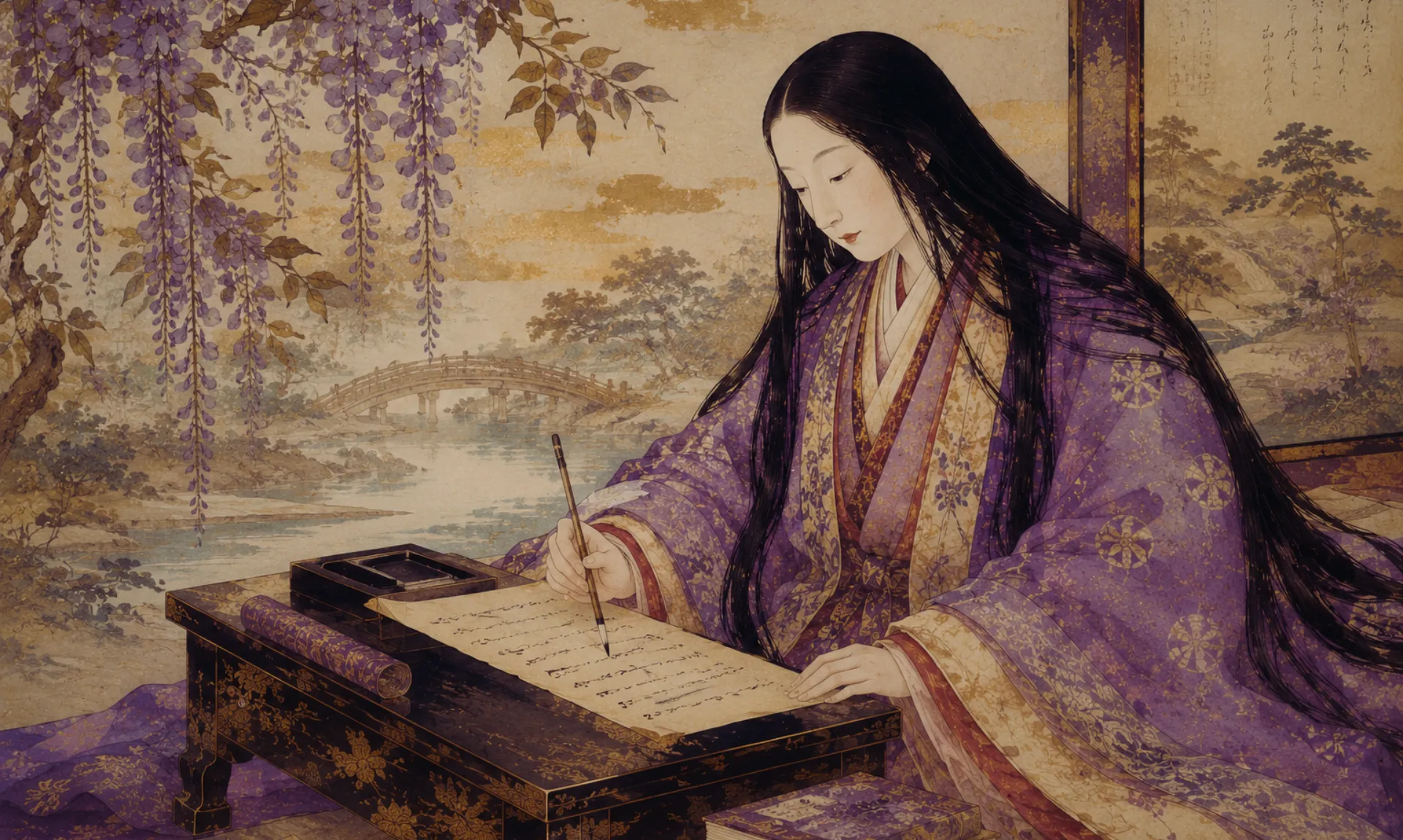
Murasaki Shikibu: The World’s First Novelist
This post may contain affiliate links. As an Amazon Associate and Bookshop.org affiliate, I earn from qualifying purchases at no extra cost to you.
The First Novelist in the World
The world’s first novel was written by a woman.
I think we need to take a moment and let that sink in.
Most readers have heard of Middlemarch, one of the most celebrated classics in English literature. But George Eliot wasn’t actually named George. Her real name was Mary Ann Evans, and she adopted a male pen name partly because women writers often faced prejudice and were not always taken seriously by publishers, critics, and readers.
Yet centuries before George Eliot picked up her pen, a Japanese noblewoman had already achieved something remarkable.
Around the early 11th century, Murasaki Shikibu wrote The Tale of Genji, a work that many scholars consider the world’s first novel. Written sometime around 1008 CE during Japan’s Heian period.
The Tale of Genji
the book follows the life, relationships, and romantic pursuits of Hikaru Genji while offering a fascinating glimpse into the customs, politics, and culture of aristocratic Japanese society.
Although the original manuscript no longer survives, *The Tale of Genji* has endured for more than a thousand years through copied manuscripts, translations, and modern editions. One of the most widely respected English translations is by Royall Tyler.
Who Was Murasaki Shikibu?
She served as a lady-in-waiting at the imperial court during Japan’s Heian period, a time often regarded as a golden age of Japanese culture, literature, and art. Living in what is now Kyoto, she was part of a sophisticated court society where poetry, journals, and literature flourished. Murasaki entered the service of Empress Shōshi, one of the most influential women at court, and it was within this literary environment that she produced the work that would secure her place in literary history.
More than a thousand years later, readers are still discussing, studying, and falling in love with The Tale of Genji. That alone is enough to make Murasaki Shikibu one of the most extraordinary writers who ever lived.
If you enjoy uncovering fascinating stories from history, you might also like my exploration of the mysterious legend of Edward Mordrake, a tale that has captivated and unsettled readers for generations.
Murasaki Shikibu’s Diary
Murasaki Shikibu was much more than the author of The Tale of Genji. She was also an accomplished poet and diarist whose writings provide a rare glimpse into life at the Japanese imperial court during the Heian period.
Her diary, now known as The Diary of Lady Murasaki, was not intended as a day-to-day record of her life. Instead, it consists of observations, reflections, and sketches of court life. Many entries focus on the period when Empress Shōshi was pregnant and later gave birth to a male heir, an event of great political significance at the time.
What makes the diary so fascinating is its attention to detail. Murasaki recorded court ceremonies, social customs, and the daily rituals of aristocratic society. She also revealed her sharp wit and sense of humor, making the diary surprisingly engaging for a text written over a thousand years ago.
At the same time, the diary offers insight into her personal life. Following the death of her husband, Murasaki frequently expressed feelings of loneliness and isolation. These deeply personal reflections add an emotional depth that allows modern readers to connect with her as a person rather than simply a historical figure.
Her writings also contain candid observations about the people around her, including the powerful statesman Fujiwara no Michinaga, whose behavior she occasionally criticized. These comments provide historians with valuable insight into the personalities and politics of the Heian court.
The Survival of the Diary
Murasaki’s diary continued to be admired long after her death. During the 13th century, artists created illustrated handscrolls, known as emaki, based on her writings. These beautifully painted scrolls combined text and artwork to bring scenes from the diary to life.
Although the original set is believed to have contained between ten and twelve scrolls, only four surviving sections remain today. These fragments represent a small portion of the complete work and are preserved by Japanese cultural institutions, including the Tokyo National Museum.
Today, the surviving writings are published as The Diary of Lady Murasaki and remain an important source for understanding both Murasaki Shikibu and the society in which she lived. Through her observations, readers gain a vivid picture of court life, social customs, and the experiences of one of history’s most influential writers.
Final Thoughts
Murasaki Shikibu’s legacy reminds us that literary talent has never been limited by gender. More than a thousand years ago, she produced a work that many scholars still regard as the world’s first novel, proving that women have been shaping literature since its earliest days.
History has not always been kind to female writers. In many societies and time periods, women faced significant social, educational, and publishing barriers that made it more difficult for their voices to be heard. Yet despite these challenges, women continued to write, create, and contribute to literary culture.
That is what makes Murasaki Shikibu such a fascinating figure. Long before debates about representation in literature, she was already producing a complex and influential work that would survive for over a millennium.
So the next time someone suggests that women’s contributions to literature are a recent development, remember Murasaki Shikibu. Remember that one of the oldest and most celebrated novels in human history was written by a woman.
And perhaps that’s the most remarkable part of her story: more than a thousand years later, readers around the world are still discovering her words.
If you enjoyed learning about Murasaki Shikibu, be sure to explore more InfoBites, book reviews, literary history, and reading recommendations here at The Reader Life. There is always another fascinating story waiting to be discovered.






[…] lives of women who found a way to write despite everything, you might want to check out my blog on Murasaki Shikibu — the woman often credited as the world’s first novelist. It’s a quiet little dive into […]
[…] For him, looking closely was the beginning of understanding. If you like exploring the geniuses of the past, you will enjoy reading my piece on the world’s first novelist! […]