
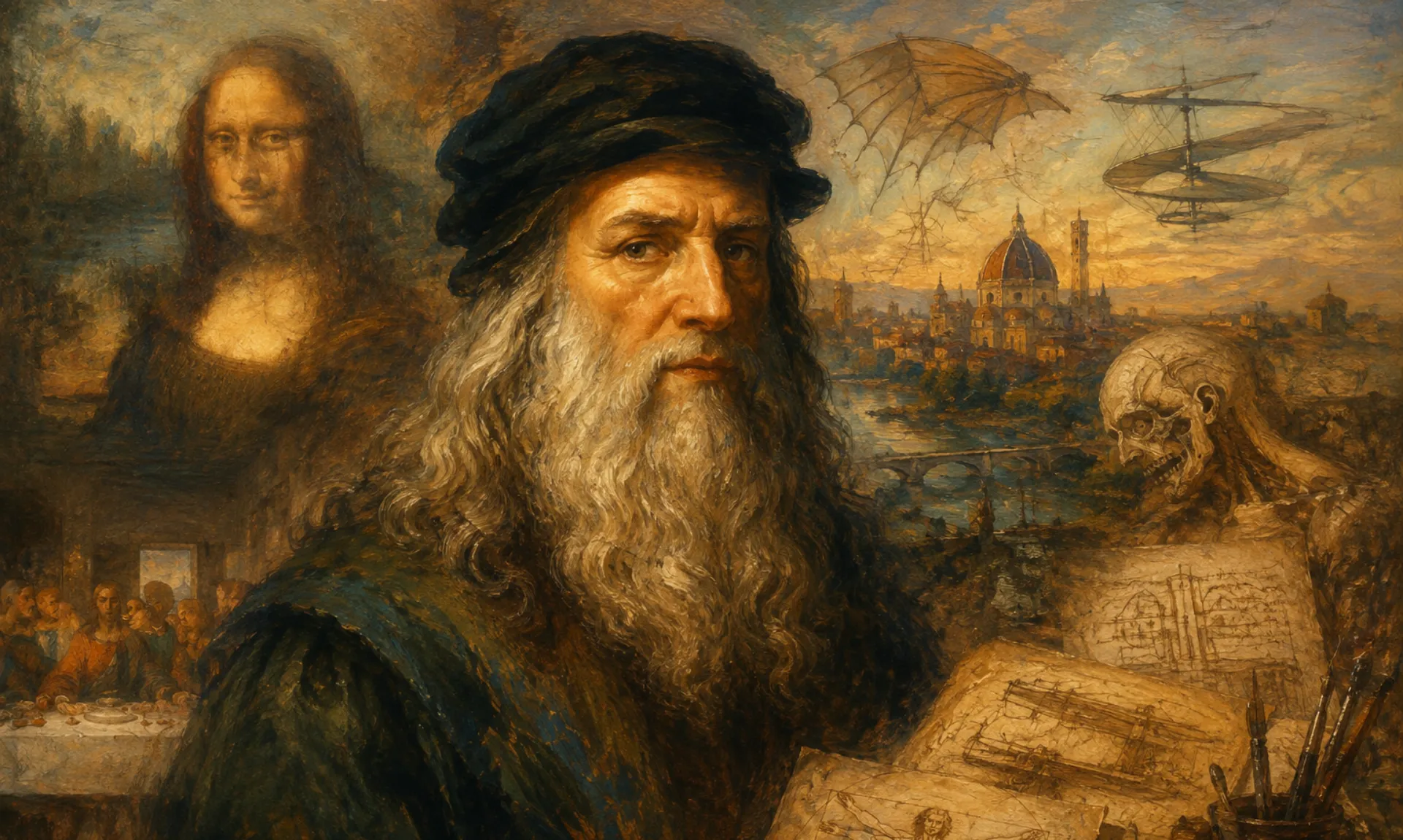
Leonardo da Vinci: The Renaissance Mind That Knew No Boundaries
This post may contain affiliate links. As an Amazon Associate, I earn from qualifying purchases at no extra cost to you.
Table of Content
Most of us meet Leonardo da Vinci through the Mona Lisa. She is mysterious, endlessly reproduced, and probably one of the most recognizable faces in the history of art. But the painting is only one tiny window into Leonardo’s mind.
Leonardo da Vinci was an artist, inventor, anatomist, engineer, architect, mathematician, musician, and obsessive observer of the natural world. He left behind thousands of pages of notes filled with questions, drawings, experiments, inventions, and observations. Basically, Leonardo had a serious problem with sticking to one subject. And that is what makes his story so fascinating.
A Quick Look at Leonardo da Vinci
Born: 1452, near Vinci, Tuscany, Italy
Died: 1519, Amboise, France
Known for: Painting, drawing, anatomy, engineering, architecture, scientific observation, and invention
Famous works: Mona Lisa, The Last Supper, Virgin of the Rocks, and Lady with an Ermine
Era: Italian Renaissance
Leonardo trained as an artist in Florence in the workshop of Andrea del Verrocchio, but his interests quickly stretched far beyond painting. He became one of the most remarkable polymaths of the Italian Renaissance, studying subjects that seem almost comically unrelated until you realize that, for Leonardo, they were all connected
Beyond the Mona Lisa
The Mona Lisa is probably the first thing that comes to mind when you hear Leonardo da Vinci. But here’s the funny thing: Leonardo didn’t leave behind hundreds of paintings.
Only around 15 paintings are generally considered to survive, and several of his works were left unfinished. His curiosity and constant experimentation often pulled him away from commissions and toward whatever question had caught his attention next.
And there were plenty of questions. How does a bird stay in the air? How does water move? How do muscles work beneath the skin? How does light behave? What makes the human eye see? Could a machine allow humans to fly?
Leonardo wanted answers to all of them. His paintings were extraordinary, but they were only one part of a much bigger obsession: understanding how the world worked.
His Notebooks Were Basically His Second Brain
More than 6,000 pages of Leonardo’s notes and drawings survive, later gathered into collections known as codices. They contain studies of anatomy, geometry, hydraulics, architecture, astronomy, engineering, flight, geology, plants, animals, art, and much more.
And they aren’t exactly organized. A page could contain a mathematical calculation, followed by a sketch of a machine, followed by an observation about water. It feels less like reading a carefully organized scientific textbook and more like accidentally opening the world’s most interesting brain dump.
Some of the notebooks even contain notes about clothing, costumes, hats, recipes, and other everyday matters, because apparently even while thinking about anatomy and flying machines, Leonardo occasionally needed to remember something about a hat. His notebooks also reveal something important about the way he thought. He was deeply suspicious of knowledge that wasn’t supported by observation. As Leonardo wrote:
“Experience has been the mistress of whoever has written well; and so as mistress I will cite her in all cases.”
For him, looking closely was the beginning of understanding. If you like exploring the geniuses of the past, you will enjoy reading my piece on the world’s first novelist!
Why Did Leonardo da Vinci Write Backwards?
One of the strangest things about Leonardo’s notebooks is his handwriting. He often wrote from right to left, producing what we now call mirror writing. If you hold the page up to a mirror, the writing becomes much easier to read.
Naturally, this has led to plenty of speculation. Was Leonardo trying to hide his ideas? Was he keeping secrets? Nobody knows for certain.
One practical explanation is that Leonardo was left-handed, and writing from right to left may simply have helped prevent him from smearing the ink as his hand moved across the page. Whatever the reason, it certainly makes his notebooks feel even more mysterious.
He Wanted to See What Was Under the Skin
Leonardo didn’t study anatomy because he was simply fascinated by human bodies. He was an artist. If he wanted to understand how a person moved, he needed to understand what was happening beneath the skin.
So he studied bones, muscles, nerves, blood vessels, organs, and even fetal development. He carried out dissections and produced incredibly detailed anatomical drawings. This wasn’t separate from his art. It was part of it.
Leonardo wanted to know why a shoulder moved the way it did. He wanted to understand the structure of the hand. He wanted to know how muscles changed when a person moved. His scientific curiosity was making him a better artist. And his artistic eye was helping him become a better observer. He wrote:
“The eye… called the window of the soul, is the chief means whereby the understanding may most fully… appreciate the infinite works of nature.”
For Leonardo, seeing wasn’t passive. It was a way of learning.
Yes, Leonardo Was Thinking About Flying
Then we get to the part that makes Leonardo da Vinci sound like he accidentally wandered into the Renaissance from the future.
He was fascinated by flight. Leonardo studied birds and the mechanics of movement and designed several flying machines. His notebooks contain designs for winged machines, a parachute-like device, and the famous aerial screw that is often compared to a helicopter. They weren’t modern aircraft, and Leonardo didn’t actually build a working helicopter.
But he was asking the right kind of question: Could humans fly?
And instead of leaving the idea as a fantasy, he tried to understand the mechanics behind it. That is very Leonardo. Give him a completely impossible idea and he’ll probably spend the afternoon drawing a diagram of it.
Leonardo Wasn’t Always Right
It is tempting to talk about Leonardo as if he knew everything. He didn’t.
Some of his scientific theories were wrong. His ideas about the moon, water, geology, and other natural phenomena sometimes reached conclusions that we now know were incorrect. But I actually think this makes him more interesting.
Leonardo wasn’t extraordinary because he magically knew all the answers. He was extraordinary because he kept asking questions. He observed. He experimented. He drew. He changed his mind. He tried again.
His famous curiosity wasn’t about being right all the time. It was about refusing to stop investigating. As he put it:
“Wisdom is the daughter of experience.”
And that idea seems to sit at the heart of almost everything he did.
The Painter Who Left Behind More Than Paintings
Here is something I find genuinely surprising about Leonardo da Vinci. Despite being remembered as one of history’s greatest painters, only around 15 paintings are generally considered to survive today. But that doesn’t mean Leonardo left behind very little art.
Thousands of his drawings survive, including anatomical studies, sketches for paintings, portraits, studies of animals and plants, architectural designs, and ideas for machines. His notebooks and loose papers give us a much bigger picture of his work than his finished paintings alone ever could.
And that makes his legacy even more interesting. We have the masterpieces everyone knows, but we also have thousands of drawings showing us how Leonardo actually thought his way toward them.
Part of the reason there aren’t more finished paintings is that Leonardo was famously slow and often left projects unfinished. His curiosity constantly pulled him toward something else. He could be working on a painting and suddenly become fascinated by anatomy, water, perspective, engineering, or some new experiment. His problem wasn’t a lack of ideas. It was probably having far too many of them.
Everything Was Connected
Perhaps the most interesting thing about Leonardo da Vinci is that he didn’t think of art and science as completely separate worlds. His anatomy studies helped his paintings. His understanding of light affected how he represented people and landscapes. His study of nature influenced his drawings. His mathematical interests helped him understand perspective. His engineering experiments encouraged him to think about movement and structure.
For Leonardo, the world was one enormous puzzle. You couldn’t really understand a painting without understanding light. You couldn’t understand the human figure without understanding anatomy. You couldn’t understand flight without studying birds. Everything connected to something else. And once you start looking at Leonardo that way, his enormous range of interests makes much more sense.
The Leonardo da Vinci Worth Remembering
We tend to remember Leonardo da Vinci as a genius. But “genius” is such an easy word to use that it doesn’t tell us much anymore.
What fascinates me more is his curiosity. He looked at ordinary things and refused to treat them as ordinary. A bird flying through the sky became a question about aerodynamics. A hand became a study of bones and muscles. A river became a problem to solve. A painting became an investigation into light, perspective, anatomy, and human expression.
And his notebooks became a record of a person who seemed almost incapable of looking at the world without asking another question. There is a quote attributed to Leonardo that feels particularly fitting:
“Nothing can be loved or hated unless it is first known.”
Perhaps that is the Leonardo da Vinci we should remember. Not only the painter of the Mona Lisa, or the Renaissance genius. But the man who wanted to know. He spent his life observing, questioning, drawing, experimenting, getting things wrong, trying again, and following his curiosity wherever it took him. And perhaps his greatest masterpiece wasn’t a painting at all. It was the mind that kept asking what was beyond it.
Enjoyed this little journey? Explore more Infobites from The Reader Life for fascinating stories, forgotten details, and the lesser-known sides of the people who shaped art and literature.