

This post may contain affiliate links. As an Amazon Associate and Bookshop.org affiliate, I earn from qualifying purchases at no extra cost to you.
Table of Content
Book Snapshot

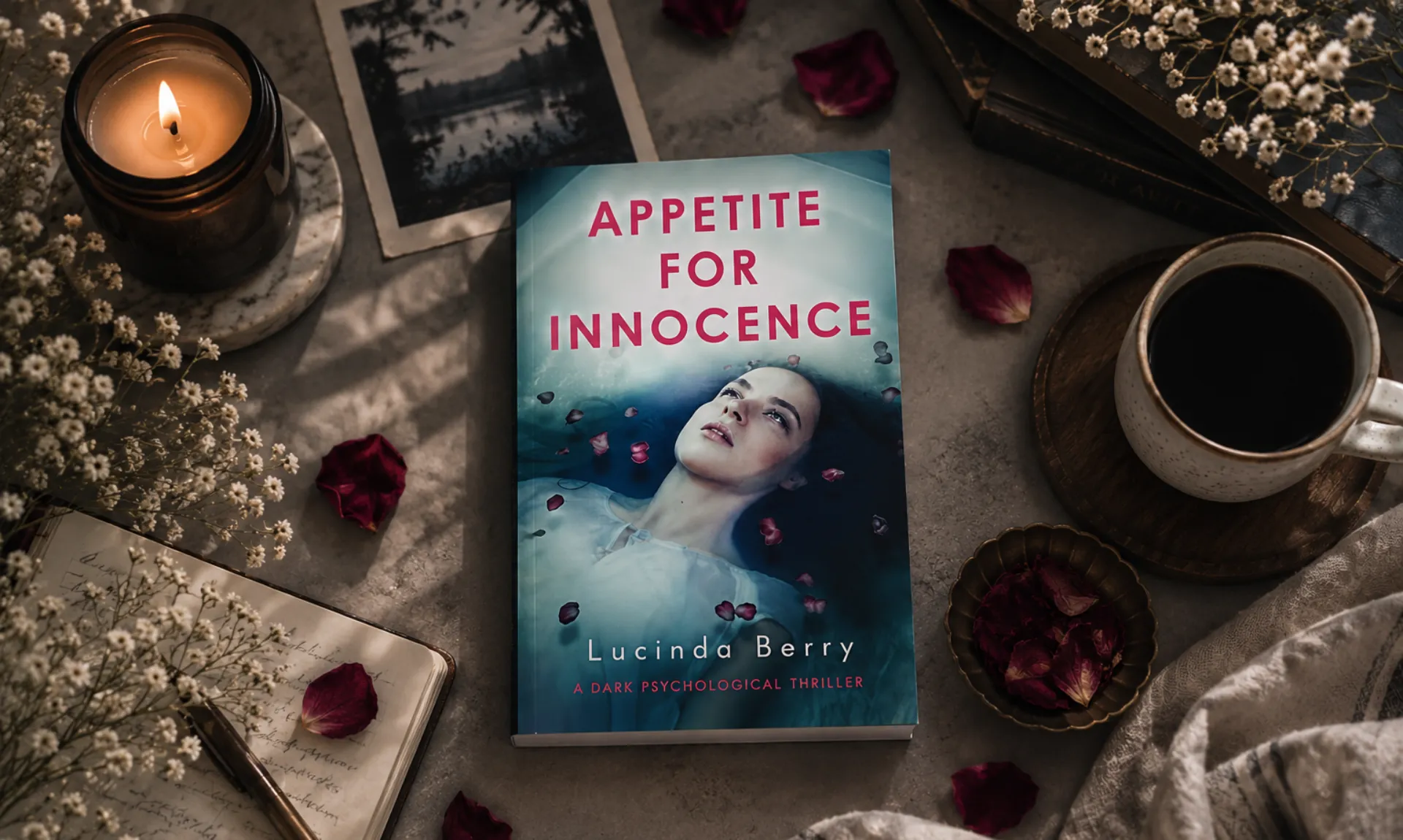
Appetite for Innocence by Lucinda Berry is the kind of psychological thriller that makes you question why you picked it up in the first place. And I mean that as a compliment.
There are authors you recommend when someone tells you they’re getting into thrillers. And then there is Lucinda Berry. I wouldn’t necessarily recommend Berry to a beginner, not because her writing is difficult, because it really isn’t, but because her stories are the kind that make you stop reading and think, how can people like this exist? And why, in the world, am I putting myself through this?
Her writing is actually very accessible. You can fly through her books. The problem is what you’re flying through. So if you’re new to Lucinda Berry, be careful with Appetite for Innocence; maybe don’t read it!
And if you do, be very careful!
This isn’t just another psychological thriller about kidnapping. It is a disturbing story about childhood, grooming, captivity, trauma, Stockholm syndrome, and what happens to a child’s mind when someone systematically destroys their understanding of safety and love.
If you like dark psychological thrillers, I have got just the right book recommendation list for you!
Appetite for Innocence Book Review: What Is the Book About?
Appetite for Innocence follows Ella and Sarah, two teenage girls who are held captive by a serial predator known to them as John. The story is told through their perspectives and moves between Then, when the girls are imprisoned, and Now, after they have escaped and are trying to live with what happened to them.
John’s real identity is eventually revealed as Derek Hunt. He targets teenage girls, kidnaps them and keeps them imprisoned in a soundproof basement before abusing them. But the more I think about this thriller, the more I realize that Derek isn’t really the most interesting part of the story.
We already know he’s a monster. The real question is:
What does a monster do to a child who cannot escape him?
And that is where Lucinda Berry’s Appetite for Innocence becomes much more than a disturbing thriller. You’re not just watching a story unfold, you’re seeing, up close, what people like John are capable of, how far they can go, and just how disturbingly twisted, cruel, and downright disgusting human beings can be.
But what I also really appreciated was how Berry doesn’t stop at Ella and Sarah. The book is filled with characters who have their own histories, wounds, and ways of surviving what life has thrown at them. Ella’s mother, in particular, is a beautifully complicated character whose own experiences shape how she responds to her daughter’s trauma. We also get glimpses into the lives of the other girls who have been trapped in that basement, along with the people who enter Ella and Sarah’s lives after their rescue. These aren’t characters who exist simply to move the plot forward; Berry gives many of them their own pain and struggles, reminding us that trauma doesn’t belong to just one person.
Ready to read it? Appetite for Innocence on Amazon · Bookshop
Lucinda Berry Is Not for Beginners
Major Spoilers Ahead!
Let me repeat this because I genuinely mean it. Lucinda Berry is not for beginners. She writes very clear and easy prose, her writing is straightforward, readable and often very fast-paced. You can easily find yourself saying I’ll just read one more chapter and suddenly realizing it’s 3 a.m. in the morning.
The problem is that her stories make you wonder what is wrong with humanity. You finish a chapter and think: People actually do this? And then you remember that unfortunately, yes, people do, that’s why there’s a book about it!
That is why I think you need to know what you’re getting into before picking up a Lucinda Berry psychological thriller. And Appetite for Innocence is particularly brutal. There are scenes I genuinely wish I didn’t have to read.
There are moments where the fact that these girls literally children, chained and locked away to satisfy a predator, is so horrible that I almost wished the book didn’t exist. And yet, strangely, I also hope books like this find readers, because these things happen. There are children who go missing. Children who are groomed. Children who are abused. Children whose suffering happens behind ordinary doors while the rest of the world carries on.
The scene involving Ella’s pregnancy was probably one of the hardest parts of this book for me. I don’t even know how else to say it. It was awful. And I think the reason it affected me so much is because it represents one more thing that has been taken away from Ella: control over her own body. Her decision surrounding the pregnancy becomes part of her attempt to reclaim some control over what happens to her. It’s horrific. It’s heartbreaking. And it is very difficult to read.
Maybe that is one uncomfortable purpose of fiction like this: forcing us to look at something we would rather not look at. Even while writing this review, I am getting goosebumps thinking about some of these scenes. I genuinely hope nobody ever has to experience anything remotely like this.
The Horror of Being a Child With Nowhere to Go
One of the things that affected me most about Appetite for Innocence is how Berry makes us understand the girls’ suffering without needing to constantly explain it. Sarah says:
“You start to go crazy after a while when there’s nobody to talk to and nothing to do.” p. 28
That is such a simple sentence. And somehow that makes it worse. Sarah isn’t giving us some complicated explanation of psychological torture. She’s simply telling us what happens when a child is isolated for so long that there is no one to speak to and nothing to occupy the mind. You start going crazy. And when you think about it, that is terrifying.
We underestimate isolation because we experience it voluntarily. We put our phones down. We go outside. We call someone. We open a book. We talk to a friend. These girls have none of that. Their entire world has been reduced to a basement, a set of rules and the person controlling them. Sarah has been living inside that reality for years. Ella is entering it. And the reader is forced to experience the contrast between the two.
If you want a creepy, addictive thriller without quite as much emotional heaviness, check out my review of The Only One Left. It has plenty of darkness and twists, but the vibe is completely different: more eerie, mysterious, and unsettling, but not devastating.
We Never Get Derek’s Point of View (Maybe That’s the Point)
Another interesting decision in this psychological thriller is that we never get Derek’s point of view. The only perspectives we really experience are Sarah’s and Ella’s. So we meet this man almost entirely through the eyes of the girls he has imprisoned. Sarah says:
“He has an appetite for innocence and a very short attention span. It’s not a good combination.” p. 124
And I think that line tells us almost everything we need to know about him without actually letting us inside his head. But here is where I have a criticism. I wanted more from Derek I wanted to know what happened to him. What made him become this person? Why did he start? Why did he develop this obsession with innocence? What was going through his mind when he first decided to take a girl?
And, honestly, did he get what he deserved? I wanted more closure. But I also understand why Berry doesn’t give it to us. This isn’t really Derek’s story. Giving him a detailed backstory could have made the book more about understanding the monster than understanding his victims. And I don’t think Berry wants us to sympathize with him. In fact, refusing to give him that much space almost feels deliberate.
The girls have already had enough of their lives taken over by him. Why should he get more pages? Still, as a reader, I wanted to know what happened to him and whether he actually faced the consequences I felt he deserved. So this is probably my biggest criticism of the book.

Ella’s Faith Doesn’t Survive What Happens to Her
One of the most heartbreaking moments comes when Ella says:
“If God can let something like this happen, then God’s a horrible person and I want nothing to do with him.” p. 127
And this is where you really see how a child’s mind works. Ella isn’t sitting there trying to make some philosophical argument. She’s a child trying to make sense of something that doesn’t make sense. If God is good, why didn’t He stop this? If adults are supposed to protect children, why didn’t anyone protect her? If the world is supposed to be safe, why did this happen?
And when none of those questions have satisfactory answers, the child starts questioning the entire structure of reality. I found that heartbreaking, because childhood depends on certain assumptions. Your home is safe. Your parents will protect you. Adults know what they’re doing. Bad things happen, but someone will come and make them right. And then something like this happens. What exactly is a child supposed to do with that?
The Then and Now Perspective Makes the Story Even More Disturbing
I really liked Berry’s decision to tell Appetite for Innocence through Then and Now.
The Then sections show us the girls’ captivity. The Now sections show us what happens after they escape. And this distinction matters enormously because if the book ended with the girls being rescued, we could close it and think: Thank God. They’re safe now.
But they aren’t safe. Their bodies are out, their minds are still trapped in that basement of horrors. Ella explains this beautifully:
“I’m glad I can’t have children. I don’t want to bring a child into this world. I used to think the world was a good place. Now I know it was only a fairytale. Bad things happen and they happen all the time. They’re everywhere. You can’t stop them.” p. 190
And honestly? I think she’s right. Or at least, I understand why she thinks she’s right. Because sit down and really think about it. Look at the cases we hear about constantly. The Epstein case. The abuse cases involving children and vulnerable people. We just heard of the Siders Case in Ohio. Then the stories coming out of India, Pakistan, Afghanistan, Sri Lanka and elsewhere around the world. You don’t have to search for long before you find another story about a child being failed by the adults or institutions that were supposed to protect them.
The scale of the Epstein case alone has continued to produce investigations and public scrutiny, with the U.S. Department of Justice maintaining a dedicated Epstein Library containing released materials. And these aren’t only stories from the United States. There are cases across South Asia too.
And this isn’t limited to one country or one part of the world. From India, Pakistan, Sri Lanka, and Afghanistan to the US, UK, Europe, Africa, and Southeast Asia, cases of child abuse, exploitation, trafficking, and institutional failure continue to surface. Some make headlines; countless others never do. And when you really sit with that reality, Ella’s belief that “Bad things happen and they happen all the time. They’re everywhere” becomes painfully difficult to dismiss.
I’m not saying these real-world cases are the same as the fictional story. They aren’t. But they make Ella’s statement hit differently. The world is not the safe fairytale children are taught to believe it is. And perhaps that is one of the cruellest things Derek takes from these girls: he shatters their belief that the world can be trusted.
Ella’s Pain Turns Into Dissociation
And then we get this:
“I want something to hold on to, but there’s nothing there anymore. I feel like I’m flying or falling, never steady or planted on anything solid. I’m unstuck from the world around me. Now I just float in empty, vast darkness.” p. 191
This passage genuinely stayed with me because Ella isn’t simply sad. She’s disconnected from reality. She’s trying to find something solid to hold onto, but there is nothing. The novel shows that surviving something doesn’t mean you’re immediately healed from it. You can leave the basement. You can be physically safe. You can have people around you. And still feel like you’re floating somewhere outside your own life. That is the kind of trauma Berry is interested in; she is barely focusing on the dramatic moment of rescue because she is deeply interested in the aftermath.
Sarah Is the Character I Couldn’t Stop Thinking About
And then there is Sarah. I genuinely don’t know whether I wanted to hug her or scream at her. Probably both.
Sarah is the most psychologically complicated character in the book because she doesn’t fit neatly into the role of victim. She was taken when she was twelve. Her biological father, Enrique, was abusive and eventually sold her to Derek for $2,000. Just think about that. Twelve. A child!
And then she spends years being conditioned by Derek. Her understanding of love, safety and affection becomes intertwined with the person who is hurting her. And this is where Berry’s depiction of Stockholm syndrome and grooming becomes especially disturbing.
Sarah doesn’t simply obey Derek because she is afraid of him. Her entire psychological world has been constructed around him. When she is rescued she is always hoping and wondering for him to find her! That is how deeply compromised her understanding of love and connection has become.
This isn’t a normal relationship that went wrong. This isn’t some forbidden romance. This is a child who was groomed and conditioned until the person who controlled her became the person she believed she loved and cared for. And that is what makes Sarah’s character so tragic.
Sarah Was a Victim, But She Wasn’t Innocent
This is where I think Appetite for Innocence becomes more interesting than a lot of straightforward psychological thrillers. It would be easy to make Sarah completely innocent. It would also be easy to make her completely monstrous. Berry doesn’t do either.
Sarah is a victim. But she also makes choices that hurt other people. She has been manipulated. But manipulation doesn’t magically erase consequences. She deserves compassion. But compassion doesn’t mean pretending everything she does is okay. And I think that’s why I couldn’t decide whether I loved or hated her. Even near the end, I was still conflicted.
Then Jocelyn tells her:
“We all have our pain and our secrets. None of us get through this life unscathed.” p. 272
And I felt this gave me closure as well. But yes, I also feel Sarah’s pain wasn’t supposed to be this. Children are not supposed to develop philosophies about pain because adults failed them. They are supposed to worry about school, friends, books, crushes, what they’re wearing tomorrow, but not how to keep a predator happy enough to survive another day.

What Happens When the Victim Is Finally Free?
This is probably the question I kept coming back to throughout the book. What happens after the rescue? Ella gives us part of the answer. She says:
“I didn’t want to die, at least. I don’t think so. I just didn’t want to feel anything. Everything was just too heavy.” p. 297
This is heartbreaking because Ella isn’t physically trapped anymore. She is free. And yet she doesn’t want to feel. Everything is too heavy. That is the kind of damage that doesn’t disappear when someone unlocks the door. And this is why I think the book works best as a psychological thriller about trauma, rather than simply a kidnapping thriller. The actual captivity is only one part of the story. The psychological captivity continues.
If you’re enjoying this review but need something a little less heavy, I highly recommend checking out my book recommendations for beginner-friendly thrillers. There are some genuinely good gems in there, and yes, there’s a little Lucinda Berry recommendation hiding among them too, so consider yourself warned.
The Ending: Are They Really Free?
Near the end, Ella says:
“Everything feel plastic like I’m living in the movie set that used to be my life. I still haven’t made it through a full day.” p. 308
And that line basically summarizes what I took away from the entire book. Everything looks normal, but it doesn’t feel normal. Her old life is still physically there, but it feels like a movie set. Fake, distant, and unreal.
And I think that’s a devastating way to show trauma, because people outside the experience can look at you and think: You’re safe now. But safety isn’t necessarily something you can just switch back on.
And then we have Sarah. Even after everything, she still has this complicated attachment to Derek. After all, rescue doesn’t automatically undo years of conditioning. Sarah has spent so long with Derek that her understanding of love has been built around him. She doesn’t simply need to forget him. She needs to figure out who she is without him, and I don’t think the book gives us the comfort of knowing whether she can ever figure it out.
My Biggest Problem With the Ending
I liked the ending, but I also wanted more. And specifically, I wanted more about Derek. What happened to him? Did he actually get what he deserved? What was going on in his head? What did he think after everything fell apart?
I don’t necessarily need a huge villain explanation. But I wanted closure. At the same time, I understand why Berry doesn’t give us much, because as I said earlier, the book isn’t about Derek. It is about Ella. It is about Sarah. It is about what he did to them.
Giving him too much of the ending could have shifted the attention back toward him. And frankly, he has already taken enough from these girls. The story belongs to them. Still, as a reader, I wanted a little more.
Final Thoughts
So, was Appetite for Innocence good? Yes. Was it comfortable? Absolutely not. Would I recommend it to everyone? Definitely not.
This is one of those psychological thriller books where the writing is easy to read but the actual story is incredibly difficult to process. The strongest part of the book for me was Sarah. Her character is such a disturbing example of what grooming and prolonged captivity can do to a child’s understanding of love and security. And Ella’s story shows the other side of it: what happens when a child escapes physically but is still trapped psychologically.
I’ve read books about grooming and abuse before, including My Dark Vanessa and My Last Innocent Year, but Appetite for Innocence disturbed me differently. Mainly because it is not as much about grooming as it is about abuse, captivity, and torture. And also, these girls were literally children. They were trapped and locked up, all of it to satisfy a monster’s needs! That is the part I can’t stop thinking about.
I almost secretly wish this book didn’t exist. And yet, another part of me hopes it finds every reader who needs to read it, because there are children who go missing, children who are groomed, children who are abused, children who are unwanted, children whose stories we never hear, and if a disturbing psychological thriller can make us stop and think about what happens to those children after everyone else has moved on, perhaps there is a reason for stories this painful to exist.
If you made it this far, thank you for reading my Appetite for Innocence book review. And if you’re looking for your next read, stick around. The Reader Life is full of book reviews, recommendations, and the occasional rabbit hole into books you didn’t know you needed. Take a look around; you might just find your next favorite read.
Frequently Asked Questions About Appetite for Innocence
What is Appetite for Innocence by Lucinda Berry about?
Appetite for Innocence follows Ella and Sarah, teenage girls who are kidnapped and held captive by a serial predator. The novel explores their captivity and, through its Then and Now structure, the psychological consequences they experience after their rescue.
Is Appetite for Innocence a psychological thriller?
Yes. Appetite for Innocence is a psychological thriller that focuses heavily on trauma, captivity, grooming, manipulation, Stockholm syndrome and the psychological aftermath of abuse.
Who is Derek Hunt in Appetite for Innocence?
Derek Hunt is the predator who kidnaps and abuses teenage girls. The girls primarily know him as John, and the reader experiences him through Sarah and Ella’s perspectives rather than through his own point of view.
Is Appetite for Innocence based on a true story?
No. Appetite for Innocence is a work of fiction by Lucinda Berry. Its subject matter, however, draws on real psychological phenomena surrounding grooming, trauma, captivity and abusive relationships, which contributes to how realistic and disturbing the novel feels.