
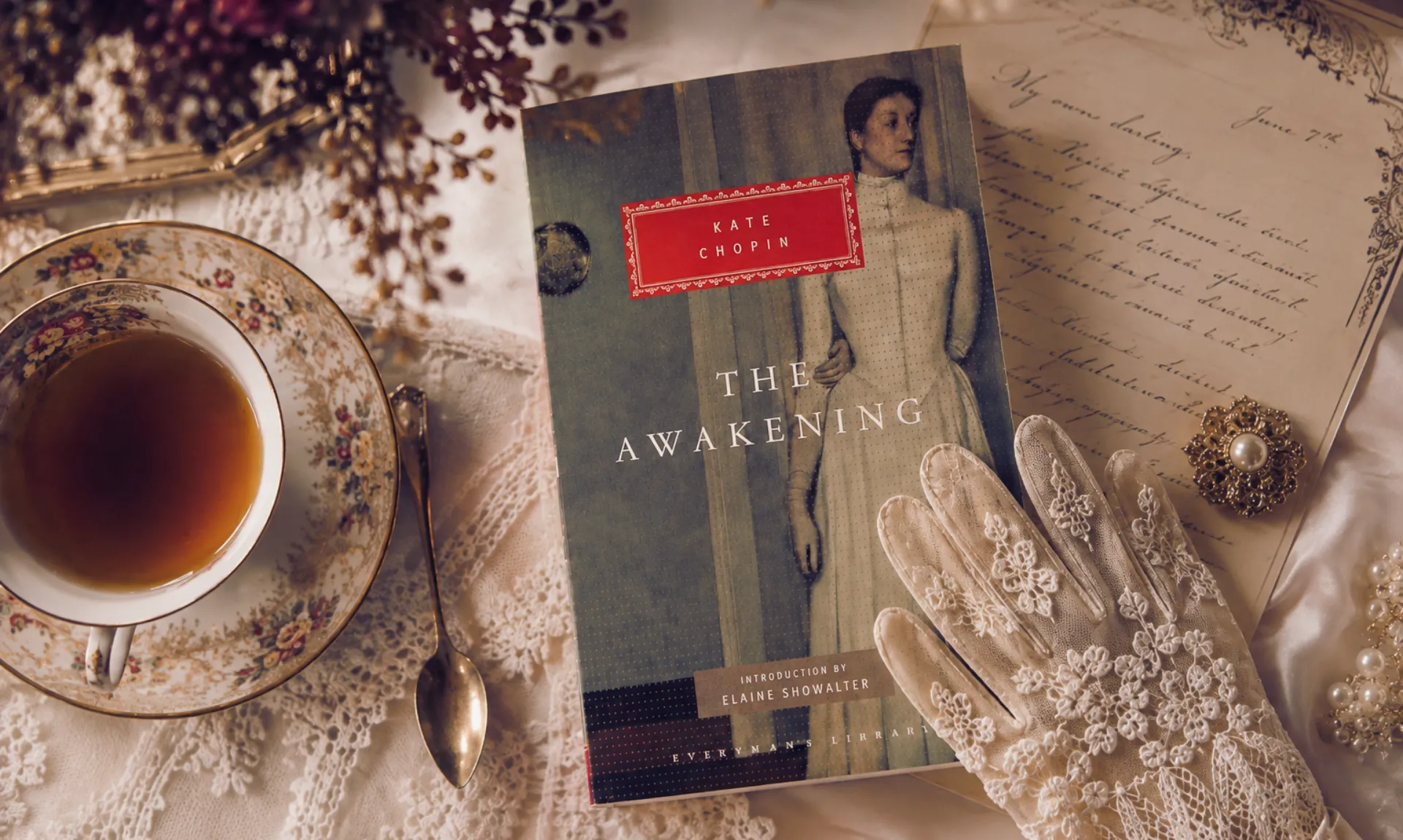
The Awakening by Kate Chopin: The Quiet Terror of Becoming Yourself
This post may contain affiliate links. As an Amazon Associate and Bookshop.org affiliate, I earn from qualifying purchases at no extra cost to you.
Table of Content
Book Snapshot
Title: The Awakening
Author: Kate Chopin
Genre: Classic Literature, Feminist Fiction
Best For: Readers who enjoy classics, complicated female characters, psychological fiction, and books that make you question the lives we are expected to live.
There is something slightly strange about reading a book published in 1899 and repeatedly thinking, Wait. Why does this feel so familiar? That was my experience with The Awakening by Kate Chopin.
I went into it expecting an important (and slightly boring) classic, and I came out thinking that it is actually a remarkably intimate book about something we still struggle to explain: what happens when you realize that the life you are living and the person you so desperately want to be are not necessarily the same thing.
And I really enjoyed exploring this conflict!
The writing does take a little getting used to. It has that slightly old-fashioned, classic rhythm, and I wouldn’t say I immediately flew through the first few pages. But once I settled into Kate Chopin’s style, I found the novel incredibly readable and simple in terms of language. The story is not particularly long, but the questions it asks are enormous.
You will end up thinking: What does it mean to be a good mother? What does it mean to be a good wife? Can you love your family and still want a life that belongs to you? And perhaps the most uncomfortable question of all: Who are you when you stop being what everyone else needs you to be?
That is where The Awakening really gets interesting. It is not your ordinary book. It is not even your ordinary classic. This book is…honestly, I don’t think I have a single adjective that can quite capture it. Maybe read the entire review, and you’ll understand what The Awakening actually contains, and why I think it is so supremely important that everyone should read it.
Anyway a quick summary for you: The Awakening follows Edna Pontellier during a summer vacation in late-19th-century America, where she starts seeing her carefully arranged life very differently. She falls for Robert, grows increasingly distant from her rather demanding husband, and finds herself pulled between Adele, the picture-perfect wife and mother, and Mademoiselle Reisz, the fiercely independent “new woman” everyone seems to think is slightly demented. Add an affair with Alcee Arobin, a growing desire for freedom, and…well, a very tragic ending.
If you want to read about female struggle from a purely contemporary perspective, I think you will love my review of Acts of Desperation by Megan Nolan; just fair warning: I think that is one of the saddest books I have read in 2026 so far…and quite disturbing too.
The Woman Edna Is Supposed to Be
Let’s start with one of the smartest ideas in the entire novel: the mother-woman. Chopin introduces us to these women at Grand Isle almost immediately:
“Mrs. Pontellier was not a mother-woman. The mother-women seemed to prevail that summer at Grand Isle. It was easy to know them, fluttering about with extended, protecting wings when any harm, real or imaginary, threatened their precious brood. They were women who idolized their children, worshiped their husbands, and esteemed it a holy privilege to efface themselves as individuals and grow wings as ministering angels.” (p. 8)
I love this passage. And honestly, mother-woman is such a clever term. Because Chopin isn’t criticizing women for loving their children. No, no, what she is trying to do here is to simply point out a particular kind of womanhood that was preferred in 19th-century society; the idea of womanhood in which being a good mother meant becoming almost entirely devoted to everyone except yourself. A mother-woman is the woman who is known for her identity of being a mother and a wife; she is not an individual because she cannot be, because society has collectively decided that she doesn’t deserve to be!
But well…Edna simply isn’t that woman. What I find fascinating is that Kate Chopin doesn’t need some enormous feminist speech to tell us this. She gives us a phrase. And suddenly you understand the entire problem.
Edna Has Been Living Two Lives
One of my favorite lines in the book comes when Chopin describes Edna’s early awareness of herself:
“At a very early period she had apprehended instinctively the dual life—that outward existence which conforms, the inward life which questions.” (p. 12)
This might be the best description of Edna’s awakening. Because she isn’t suddenly transformed into a completely different person. She has always had an inner life. There is the outward Edna, who does what is expected. And there is the inward Edna, who keeps asking questions. That distinction feels incredibly modern to me.
We all have versions of ourselves that exist in different spaces. There is the person everyone knows and the person who sits alone at night thinking about things nobody else knows you are questioning. For Edna, that distance eventually becomes too large to ignore. And once you begin questioning your life, it is very difficult to go back to living it unquestioningly. That, to me, is the real beginning of her awakening. Not that handsome Robert, or the sea, or the thrill of romance, but these questions that make her anguished even when she behaves like a perfect wife!
“She Wanted to Swim Far Out”
The sea obviously becomes one of the most important images in the novel, but I love how physical Edna’s awakening is. Chopin writes:
“She wanted to swim far out, where no woman had swum before.” (p. 23)
There is so much packed into that little sentence. Edna isn’t simply learning to swim. She wants to go somewhere no woman has gone before. And suddenly swimming becomes about possibility. She is discovering what her body can do, what she can experience, and what it feels like to move somewhere without waiting for permission.
I also think this is why the novel feels much more alive than you might expect from a nineteenth-century classic. Edna doesn’t simply sit around having philosophical thoughts about freedom. She experiences her awakening. She swims, and paints. She walks alone and falls in love. She wants and wants without being apologetic about it! She gets angry. She becomes selfish. She becomes lonely. She makes decisions that aren’t particularly sensible.
And that’s precisely why I don’t think Edna works as a perfect feminist heroine. She isn’t perfect. She’s messy. She’s sometimes frustrating. She doesn’t always understand herself. But perhaps that’s the point. She isn’t supposed to represent some perfect version of liberated womanhood. She’s trying to figure out what liberation even means to her.
If you are wondering whether classics are really your thing, try some of the books I recommended in my guide for beginner-friendly classics. Btw, I have also shared some safe and legal platforms to download classic books for free!
Then Robert Leaves…and Everything Feels Different
Robert’s departure is one of those moments where you realize just how much Edna’s internal world has changed, and it happens way sooner than you expect, almost at the beginning of the novel. Chopin then writes:
“The conditions of her life were in no way changed, but her whole existence was dulled, like a faded garment which seems to be no longer worth wearing. She sought him everywhere—in others whom she induced to talk about him.” (p. 40)
This is heartbreaking because nothing has actually changed. Edna still has the same house. The same children. The same husband. The same responsibilities. But now she sees all of it differently. And isn’t that sometimes the most painful part of realizing something about yourself? The world doesn’t change with you. You change, and suddenly the world you were perfectly capable of living in yesterday doesn’t fit quite as comfortably anymore.
Robert becomes important to Edna, but I don’t think The Awakening is really a romance. Robert is part of what opens something in her, but the larger discovery is Edna herself. And that distinction matters, because if this were simply a story about a woman falling in love with another man, it would be a much smaller novel. Chopin is asking what happens when a woman begins wanting a life that isn’t about other people, that’s purely hers!
“I Wouldn’t Give Myself”
Then we arrive at one of the most important statements Edna makes:
“I would give up the unessential; I would give my money, I would give my life for my children; but I wouldn’t give myself.” (p. 41)
I actually think this is one of the lines that makes Edna so easy to misunderstand. At first, it can sound selfish. But read it again. She says she would give her life for her children. What she refuses to give is herself. And those aren’t necessarily the same thing.
What does “myself” mean here? Her identity? Her desires? Her individuality? Her ability to make choices? Her sense that she exists as a person beyond being somebody’s mother? That’s what makes the line so uncomfortable, because Edna isn’t saying, I don’t care about my children. She’s saying, I don’t believe loving them should require me to stop existing as an individual. And I think that is a much more complicated idea.
It also makes the mother-woman passage earlier in the novel even more important. The problem isn’t motherhood itself. The problem is the expectation that motherhood should consume the woman completely.
Awakening Doesn’t Automatically Make You Happy
And this is something I really appreciated about Chopin. She doesn’t romanticize self-discovery. Edna doesn’t wake up, discover feminism, buy a nice dress, and suddenly have everything figured out. Also…if only personal growth came with that kind of convenient packaging.
Anyway, what happens that she becomes increasingly confused. At one point, Chopin writes:
“There were days when she was unhappy, she did not know why,—when it did not seem worth while to be glad or sorry, to be alive or dead; when life appeared to her like a grotesque pandemonium and humanity like worms struggling blindly toward inevitable annihilation. She could not work on such a day, nor weave fancies to stir her pulses and warm her blood.” (p. 50)
This is where the novel becomes much darker, because sometimes becoming aware of yourself doesn’t immediately make you happier. Sometimes it makes you more aware of what is missing.
Edna has started seeing possibilities, but she doesn’t yet know how to build a life around them. And that creates a strange kind of loneliness…a void that cannot be filled! Chopin captures it beautifully later:
“On rainy or melancholy days Edna went out and sought the society of the friends she had made at Grand Isle. Or else she stayed indoors and nursed a mood with which she was becoming too familiar for her own comfort and peace of mind. It was not despair; but it seemed to her as if life were passing by, leaving its promise broken and unfulfilled. Yet there were other days when she listened, was led on and deceived by fresh promises which her youth held out to her.” (p. 60)
Life were passing by, leaving its promise broken and unfulfilled. That feeling is devastating, and not because Edna has nothing, but because she suddenly feels that she could have had something else. And I think that is one of the most painful forms of dissatisfaction: not knowing that your life is terrible, but wondering whether it could have been different.
“What Character of a Woman I Am”
At one point in the novel, Edna is with Arobin and they are having a discussion when she says,
“One of these days, […] I’m going to pull myself together for a while and think—try to determine what character of a woman I am; for, candidly, I don’t know.” (p. 70)
That is Edna’s real question. What character of a woman am I? Not what kind of wife, or what kind of mother. But what kind of woman! I think this is where The Awakening becomes much bigger than Edna’s particular story. Because that question isn’t really nineteenth-century related. The circumstances are but the question isn’t!
We spend so much of our lives being told who we are supposed to become. Good daughter. Good wife. Good mother. Successful woman. Independent woman. Feminine woman. Strong woman. And sometimes we don’t stop to ask whether any of those versions actually feel like us.
Edna does. She thinks about it all…all of it, and she doesn’t have a very comfortable answer.
If you like unsettling stories about female existence, I think you are gonna love my book review of Annie Bot by Sierra Greer.
Why This Classic Still Feels So Relevant
This is probably what impressed me most about The Awakening. It would be very easy to read a nineteenth-century novel about marriage and motherhood and think, Well, obviously things were different back then. And they were.
Women today have choices Edna could hardly have imagined. But social expectations don’t disappear simply because society changes. The pressure to be a particular kind of woman is still very real. There is still the idea that women should naturally want marriage. That motherhood should automatically fulfill them. That a good woman should be self-sacrificing. That prioritizing yourself can make you selfish. That wanting something beyond your family requires an explanation.
And this is why I think The Awakening deserves its place among the classics. It gives us a female interiority that feels remarkably intimate. Chopin isn’t simply telling us that women should be free. She’s showing us what it feels like when a woman begins to realize that she has been living according to expectations she never consciously chose.
And there is something particularly powerful about that coming from a female perspective. A male writer could certainly write about a woman’s restrictions. But Chopin writes about the inside of them, the confusion, the guilt, the desire, the boredom, the excitement, the loneliness, the fact that you can love someone and still want to escape, and the fact that you can be grateful and dissatisfied at the same time. Those contradictions are what make the book feel alive.
The Ending Is Where Everything Gets Complicated
Major Spoilers Ahead!
Okay, now we have to talk about the ending. And I don’t think Edna’s ending can be reduced to one neat interpretation.
By this point, she has tried to create a life that belongs to herself. She has moved further away from the identity expected of her, but she hasn’t discovered some perfect alternative. Freedom, as it turns out, is not particularly simple, and neither is love!
When Edna finally steps into the sea, she recalls Robert. The final moments are:
“Good-by—because I love you.” He did not know; he did not understand. He would never understand. (p. 98)
That last part is devastating. He would never understand, and you feel as if he stands for the entire patriarchal structure. Robert loves Edna, but he doesn’t fully understand what she is trying to become. But then…no one does! No one around her, men or women, understands her conflict. And perhaps that is the tragedy of the entire novel. Edna wants to belong to herself, but the people around her understand her mainly through the roles she occupies. The role of wife, mother, even a lover. Everyone seems to have an idea of who Edna is supposed to be. Edna herself is the only person still trying to figure it out.
And by the end, she doesn’t find a way to reconcile those two realities. I don’t think the ending is meant to be comforting. It isn’t a triumphant “Edna has finally escaped!” moment. It is much sadder than that. Her awakening gives her awareness, but awareness does not automatically give her the freedom to live the life she imagines. And perhaps that is one of Chopin’s most devastating ideas: What if you wake up before the world is ready to let you live differently?
What I Loved About The Awakening
For me, the biggest strength of this book is how quietly complicated it is. Chopin doesn’t need enormous dramatic scenes every five pages. She watches Edna change. A conversation here. A swim there. A painting. A moment alone. A feeling she can’t explain. A decision she wouldn’t have made before. And gradually, you realize that the woman who entered the story isn’t quite the woman standing at the end of it.
I also loved the way Chopin allows Edna to be flawed. I don’t agree with everything she does. I don’t think every decision she makes is admirable. But I never felt that she was supposed to be a perfect example of how women should behave. She’s trying to understand herself, and people are messy when they’re doing that. I love her as a character; I loved her even more than our dear dear Hedda Gabler.
What Took Me a Little While to Get Used To
My main hesitation with the book was the writing style. It has that classic, slightly old-fashioned quality that took me a little while to settle into. There were moments when I had to slow down and get into Chopin’s rhythm rather than expecting the prose to move like a contemporary novel.
But once I adjusted, I actually found it very readable. And considering this was published in 1899, I found myself more impressed than frustrated by the writing, because underneath that classic language is a story that is surprisingly direct. Chopin isn’t asking some obscure philosophical question that requires a dictionary and a PhD to understand. She’s asking:
What if I don’t want the life everyone says I should want?
That’s a question most readers can understand immediately, but do we really have the answer? I don’t think so…
Final Thoughts: Should You Read The Awakening?
Yes. Especially if you’re someone who thinks classics are going to be painfully slow and impossible to relate to. The Awakening might surprise you.
It is not a particularly long novel, and while the writing takes some getting used to, the story itself is fascinating. More importantly, it is the kind of book that gives you something to discuss. And I think that’s what makes a classic worth reading. A perfect classic is not just a book that survived hundreds of years and that someone randomly put on your syllabus; it is the book that you open after all these years, and still find yourself arguing with it!
You can disagree with Edna. You can sympathize with her. You can get frustrated with her. You can wonder whether she is selfish or brave or both. You can question Robert. You can think about motherhood differently. You can wonder what “freedom” actually means. And that thought process is what makes this book so worth it!
I also think The Awakening is important because it doesn’t simply tell us that women deserve freedom. It gives us a woman who is trying, sometimes unsuccessfully, to understand what freedom would even look like for her. And that is much more interesting.
If you enjoy classics with complicated women, feminist themes, psychological depth, and stories that make you question the expectations placed on us, I would absolutely recommend picking this one up.
And if you’re here because you love books that give you something to talk about long after you’ve finished them, have a look around The Reader Life. I write honest book reviews, thoughtful reading recommendations, and literary discussions for readers who want a little more than BookTok favourites.
And when you pick it up, please remember…sometimes a book isn’t supposed to give you answers, sometimes it just gives you a much better question.
Happy reading!






[…] The Awakening by Kate Chopin: The Quiet Terror of Becoming Yourself […]