
Table of Content
This post may contain affiliate links. As an Amazon Associate and Bookshop.org affiliate, I earn from qualifying purchases at no extra cost to you.
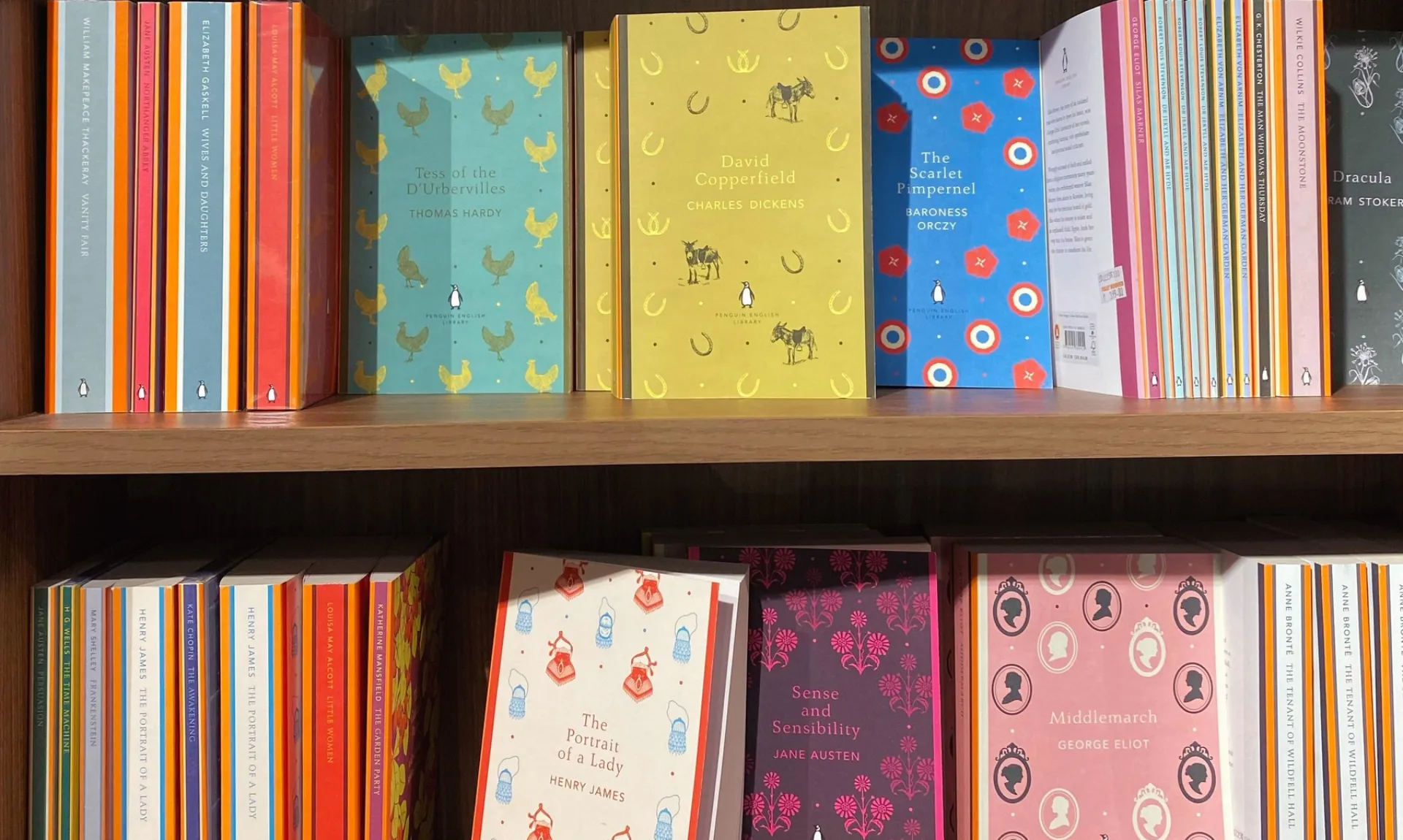
The first time I noticed a Penguin Clothbound Classic, it wasn’t in a bookshop. It was in the background of someone else’s bookshelf photo, one of those perfect rows where every spine seems to match. I zoomed in, the way you do, and found tiny repeating patterns stamped in shiny foil on coloured cloth. They looked less like paperbacks and more like something a Victorian aunt would leave you in her will.
Then I started seeing them everywhere: on BookTok, in flatlays, on the desks of people who clearly owned more candles than I do. So, naturally, I wanted to know who made them and why a series of mostly out-of-copyright novels had become the books everyone seems to collect.
The answer involves one designer, a very old idea about what a book should feel like, and a few printers who had to rethink how they worked. Here is the story behind the covers.
A Victorian Idea for the eBook Age
The series is the work of Coralie Bickford-Smith, a designer who studied typography at the University of Reading and has been designing covers for Penguin since 2002. Long before the series existed, she had become, in her own words, “really obsessed with how foil and cloth was used on Victorian bindings.”
Her starting point was an old book about Victorian publishers’ bindings in cloth and leather, and her inspiration went back even further, to the Kelmscott Press, which William Morris founded in the last years of the Victorian era to make books that were beautiful objects. As she told Penguin:
“I wanted to know how I could recreate it using a modern day printing press, for a mainstream publisher.”
The timing was interesting. E-readers were arriving, and plenty of people predicted the end of the printed book. Bickford-Smith has said the clothbound idea “was a reaction to the rise of the eBook.” If a book was going to compete with a screen, it had better be something you actually wanted to hold.
A collection called Poems for Life (2007) worked as a kind of rehearsal. Then the bookseller Waterstones showed interest in a collectible series at a friendlier price, and on 6 November 2008 the first official Clothbound Classic appeared: Sense and Sensibility, in pale blue cloth with deep pink flowers climbing the cover “like wallpaper”, as Penguin describes it.
Printers Had Never Seen Anything Like Them
Making the books turned out to be harder than drawing them. Most hardbacks of the time had a printed paper jacket and, at best, a little foil on the spine. Bickford-Smith wanted the foil pattern to wrap all the way around the cloth. Penguin’s publishing director for Classics put it simply: “There were no books like that.”
Getting even foil coverage across a whole cloth cover meant real trouble at the printers, who had to adjust how their presses worked. There was a money-saving plan too: no dust jacket meant one less thing to print. Bickford-Smith’s verdict on that idea, years later, was a dry “false economy, there.”
When the first copies finally came off the press, she went to watch, and this is how she described the moment to Penguin:
“It was just, wow. I’d actually achieved what was in my brain.”
Honestly, that is the dream for anyone who has ever sketched something on a napkin.
How Each Book Gets Its Pattern
Every Clothbound Classic follows the same simple rules: one small icon repeated across the cover, and never more than two colours. The fun is in choosing the icon, and it always starts in the same place. As Bickford-Smith puts it:
“It all begins by reading the book, thinking about the author, thinking about the period of the book.”
Some of her choices are delightfully clever once you know the story:
- Dracula is covered in garlic flowers. “I wanted to trap Dracula inside the book,” she said, so the flowers on the outside “would keep you safe.”
- Little Women has scissors, for the moment Jo cuts off her hair.
- Emma gets a row of Regency chairs, which feels exactly right for a novel about drawing rooms and meddling.
- Robinson Crusoe has moons, because Crusoe keeps track of time on his island.
- Les Misérables has columns of red songbirds on black cloth, and The Lonely Londoners has the arched rafters of a train station roof.
She also designed a grid that every book follows, and she has broken it only once, for The Monkey King, which hides a tiny monkey on the back. “I went a bit power mad and broke my own rules,” she admitted. And here is a detail I love: for years these covers skipped the usual cover meetings. “They just went under the radar,” she said, before adding that these days there is “no chance of that happening.”
From a Royal Desk to Your Feed
For a while, the books were a quiet success. Then, in April 2020, in the early days of lockdown, Kensington Palace shared photos of the Duke and Duchess of Cambridge working from home, and a row of Clothbound Classics was sitting on Kate’s desk. Bickford-Smith found “hundreds of notifications” waiting for her, and her sister texted to say her books were on the front of the Daily Telegraph.
“It seemed like these books had taken on a life of their own,” she said. That life was mostly happening online. The books became regulars in the carefully arranged flatlays of Instagram and TikTok, where collectors line them up by colour like paint swatches. By 2022, Penguin reported that the series had sold 6 million copies in 110 countries.
It makes sense when you think about it. A Clothbound Classic photographs beautifully, it looks good on a shelf even when you haven’t read it yet (no judgement), and it is a classic, so you can feel virtuous about buying it. It is the same pull I wrote about in Reading as Ritual: for a lot of us, a book is an experience as much as a text.
How Many Penguin Clothbound Classics Are There?
The series has grown steadily, a few “drops” at a time. Penguin counted more than 70 titles in 2020 and 85 by the summer of 2022. In 2025 the series reached a milestone: Edgar Allan Poe’s The Fall of the House of Usher became the 100th volume. As of November 2026, Penguin’s own series page lists 113 books, so if you were hoping to collect the full set, I admire your optimism and your shelf space.
Jane Austen readers are especially well looked after. Her novels were there from the very start (Sense and Sensibility launched the whole series), and in 2025 the Holburne Museum in Bath included Bickford-Smith’s clothbound work in its Illustrating Austen exhibition, alongside the long history of illustrated Austen.
In 2022 Penguin also launched Little Clothbound Classics, a smaller format in the same spirit, and the look has inspired other series too. When Bickford-Smith redesigned the Penguin English Library paperbacks in 2012, the brief asked for covers that echoed the look of the clothbound classics, and she was given just under a year to design 100 of them.
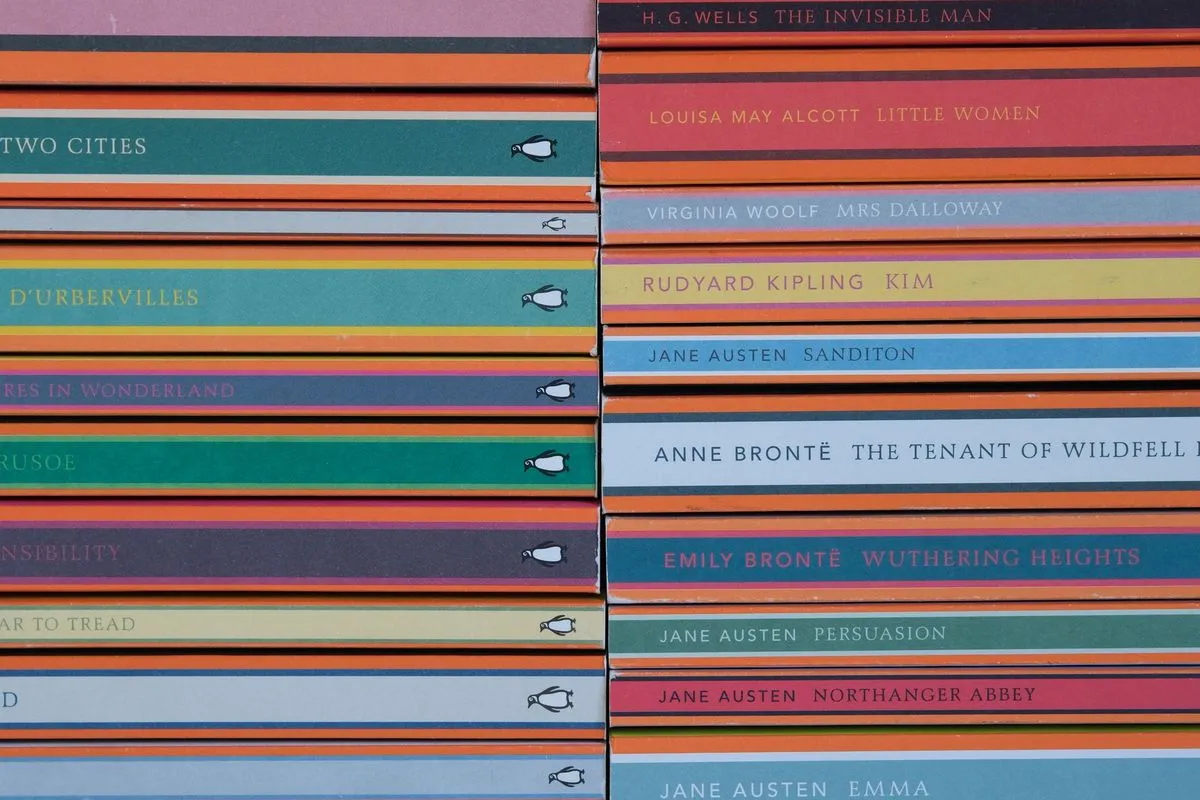
If all this has you eyeing your own shelf, here are a few editions from this story to start with:
Why Readers Can’t Stop Collecting Them
It would be easy to dismiss all this as pretty packaging. But I think the series says something real about how we read now. Nearly two decades after people predicted the end of print, publishers are leaning into the book as an object. In 2025 the Australian bookshop Readings noted that “more and more publishers are producing books like this”, with soft matte covers and no dust jackets.
Bickford-Smith’s designs have also done something quietly useful: they have put very old books into very new hands. As It’s Nice That put it back in 2014, her clothbound designs were responsible for “putting legendary literature back into the paws of the British public.” If a garlic-flower cover is what gets someone to finally open Dracula, I’m not going to complain.
Or, as she told Penguin:
“It all began with this idea of a book being loved and cherished.”
A Book You Want to Keep
What I like most about this story is that the Clothbound Classics weren’t a marketing plan. “It was not some kind of evil plan,” Bickford-Smith said. “It just happened.” A designer fell in love with Victorian bindings, a few printers rose to the challenge, and a series of mostly free-to-read classics became something people happily collect.
So the next time you see a perfect row of them in someone’s photo, you’ll know there is a garlic flower, a pair of scissors and a tiny rule-breaking monkey hiding in there.
If you enjoy the stories behind the books on your shelf, there are more in our Book Editions & Publications section. You could start with the bigger picture in our guide to Penguin Random House, or pick your next clothbound read from 5 Classics Everyone Should Read.
Research References
- Penguin: Clothbound Classics, a little history of the making of (Alice Vincent, 2022)
- Penguin: How Clothbound Classics ended up on Kate Middleton’s desk (Alice Vincent, 2020)
- Penguin: Penguin Clothbound Classics series page
- Penguin: The Fall of the House of Usher, the 100th Clothbound Classic
- Penguin: Coralie Bickford-Smith on redesigning the Penguin English Library (2018)
- Coralie Bickford-Smith: official website
- Readings: Paper, ink and glue, the wonderful world of special editions (2025)
- It’s Nice That: Bookshelf, Coralie Bickford-Smith (2014)
Frequently Asked Questions
Who designs the Penguin Clothbound Classics?
The series is designed by Coralie Bickford-Smith, a British designer and illustrator who has created covers for Penguin since 2002. She chooses a repeating icon for each book after reading it and researching its period.
When did Penguin Clothbound Classics start?
The first official Clothbound Classic, Sense and Sensibility by Jane Austen, was released on 6 November 2008. The idea grew from Bickford-Smith’s love of Victorian cloth and foil bindings.
How many Penguin Clothbound Classics are there?
Penguin’s series page lists 113 books as of November 2026. The 100th volume, Edgar Allan Poe’s The Fall of the House of Usher, was published in 2025, and new titles are still added.
What are Little Clothbound Classics?
Little Clothbound Classics are a smaller format of the series that Penguin launched in 2022. They use the same foil patterns on coloured cloth in a smaller size, in the spirit of Penguin’s Little Black Classics.