


This post may contain affiliate links. As an Amazon Associate and Bookshop.org affiliate, I earn from qualifying purchases at no extra cost to you.
Table of Content
Book Snapshot
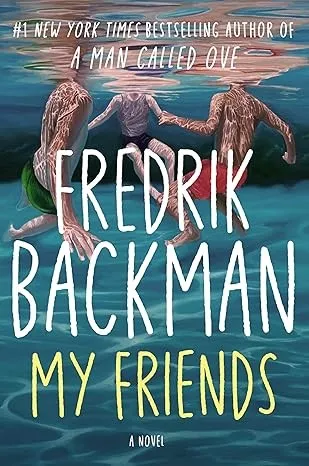
Some books make you nostalgic for a childhood you didn’t necessarily have. They remind you of a time when friendships felt permanent, summers seemed endless, and the most important thing in the world was having someone to share your ridiculous little jokes with. My Friends by Fredrik Backman is one of those books. It’s warm, funny, calming, and, before you know it, absolutely heartbreaking.
I went into this book expecting to enjoy Backman’s writing. That’s hardly a difficult prediction considering how much I enjoy his work. But I wasn’t quite prepared for how attached I would become to these characters. I loved Ted, and I loved the friendship between Ted, Joar, Ali, and Kim. There’s something incredibly tender about watching a group of children create their own little world when the one they’ve been given isn’t particularly kind to them.
And somewhere between the laughter, the sadness, the paintings, and the memories, Backman makes you think about growing up, growing apart, grief, anxiety, and all the little things that make being alive worthwhile.
What Is My Friends About?
At the centre of My Friends is a painting. It’s an extraordinary piece of art featuring a few tiny figures sitting together at the end of a pier. Most people don’t pay much attention to them. They see the sea, the colours, and perhaps a beautiful composition. But Louisa, a young aspiring artist, sees something else entirely. She wants to know the story behind those figures.
Her curiosity takes her on a journey into the lives of four teenagers who, twenty-five years earlier, found refuge in one another. Ted, Joar, Ali, and Kim are children dealing with difficult circumstances, but their friendship gives them something to hold on to. They spend their days on an abandoned pier, telling stories, laughing, and finding little ways to make life more bearable.
Their friendship eventually becomes connected to the painting, and Louisa’s attempt to understand its origins brings the past and present together.
Backman moves between timelines, gradually revealing the characters’ histories and the connections between them. The storytelling is non-linear, but it never feels like a puzzle designed to confuse you. Instead, every little revelation adds another layer to the story.
What I particularly enjoyed was how Ted’s perspective guides so much of the narrative. Through him, we get to experience the strange, funny, heartbreaking world of childhood, where everything feels enormous because, at that age, everything really is enormous.
And while the painting is what brings these stories together, friendship is what makes them worth telling.
Fredrik Backman Knows How to Write Friendship
I have a soft spot for authors who can make ordinary relationships feel extraordinary without turning every interaction into some grand philosophical moment. Fredrik Backman does this particularly well.
His characters are rarely perfect. They make mistakes, say ridiculous things, misunderstand one another, and occasionally behave like absolute idiots. But that’s precisely what makes them feel human.
In My Friends, friendship isn’t presented as some magical solution to every problem. These children still have difficult lives. Their circumstances don’t suddenly improve because they’ve found one another. But they have someone to laugh with, someone who understands, and someone who makes the world feel a little less lonely.
I loved Ted. I loved Joar. I loved Ali and Kim. More than anything, I loved watching them become a little family of their own.
There’s also something lovely about the way Backman uses humour. He can take a rather depressing observation about human existence and turn it into something that makes you laugh before you realize how accurate it is.
For instance:
“We’re a bunch of lonely apes on a rock in the universe, our breath consists of eighty percent nitrogen, twenty percent oxygen, and one hundred percent anxiety.” (p. 58)
I mean, where’s the lie?
It’s this combination of humour and emotional honesty that makes his writing so enjoyable. He understands that people can be deeply unhappy and still find something funny to laugh about. In fact, sometimes laughing is the only sensible response to the absurdity of being alive.
The Magic of Being Fourteen
I think one of the things Backman understands exceptionally well is that childhood isn’t automatically a happy time.
We tend to romanticize it as adults, remembering the freedom, the friendships, and the seemingly endless days. But childhood can also be lonely, frightening, and confusing, particularly when the people who are supposed to protect you are the ones making life difficult.
Ted, Joar, Ali, and Kim find something in one another that makes their circumstances a little easier to bear. They create a friendship that doesn’t depend on having perfect lives or being particularly good at expressing their feelings. They simply show up for one another.
I loved watching their friendship develop. There’s a particular kind of intimacy in childhood friendships that becomes increasingly difficult to find as we grow older. You don’t need to explain every little thing. You can be ridiculous, waste an entire afternoon doing absolutely nothing, and somehow feel like you’ve accomplished something important.
Backman captures this beautifully:
“It’s an act of magnificent rebellion to do meaningless things, to waste time, to swim and drink soda and sleep late. To be silly and frivolous, to laugh at stupid little jokes and tell stupid little stories.” (p. 59)
I absolutely love this passage.
There’s something wonderfully rebellious about allowing yourself to enjoy life without constantly trying to make it productive. We spend so much of adulthood worrying about deadlines, responsibilities, and the next thing we have to accomplish that we sometimes forget how to simply exist.
Perhaps that’s one of the things childhood gives us that we spend the rest of our lives trying to recover.
And then there’s this:
“We never get that age back again, when every friend is a childhood friend, we measure all infatuations throughout our lives against that.” (p. 100)
It made me think about how friendships change as we grow older. We meet people through work, university, shared interests, and all sorts of circumstances. Some become incredibly important to us. But childhood friendships occupy a different space. They belong to a version of ourselves that existed before we knew how complicated life could become.
I also particularly enjoyed Backman’s little observation about being fourteen:
“Everyone should be allowed to be fourteen for far longer than a year. There are so many other ages we could skip instead: thirty-nine, for instance.” (p. 149)
Honestly, I wouldn’t mind skipping a few adult years either.
But beneath the humour is something rather sad. Fourteen is such a strange age. You’re old enough to understand that something is wrong with the world, but often too young to know what to do with that understanding. You want independence, but you still need someone to look after you. You want to be taken seriously, but people keep reminding you that you’re just a child. Backman doesn’t forget that side of growing up.
The Things We Don’t Know How to Say
This is where the book becomes considerably heavier.
One of my favourite things about Backman’s writing is that he doesn’t treat difficult emotions as something that can always be neatly explained. Sometimes people are unhappy without knowing how to articulate why. Sometimes children experience things that adults around them cannot even begin to understand.
And I think this is particularly important when he writes about teenage anxiety and loneliness. There’s a passage that was easily my favourite in the entire book:
“No one can explain why some fourteen-year-olds want to die. Nature gains nothing from unhappy children, yet they are still walking around everywhere, without the words to describe their anxiety. Because how could you even begin to explain such a feeling to someone who has been happy and secure all their life? Should you say it’s like a monster sleeping heavily on your lungs, so that every breath feels like you’re drowning? That it’s a voice in your head screaming that everything about you is a mistake?” (p. 221)
There’s something particularly heartbreaking about the idea that a child can be struggling so much internally while having absolutely no language to communicate what’s happening. Adults often expect children to explain their feelings, but how do you explain something you’ve barely begun to understand yourself?
The comparison to a monster sleeping on your lungs is especially powerful. It’s not simply sadness. It’s an overwhelming feeling that follows you everywhere, making even the most ordinary things difficult. And perhaps the most uncomfortable part is the question of how you explain that experience to someone who has never felt it.
I think we sometimes underestimate how much of childhood happens internally. We see a child going to school, playing with friends, laughing at something silly, and assume everything is fine. But what if it isn’t? What if the child doesn’t even know how to ask for help?
This passage stayed with me because it reminds us that childhood isn’t necessarily the carefree experience we sometimes imagine it to be. Some children are carrying things they don’t have the words, the support, or even the understanding to talk about.
It’s one of the reasons I think My Friends deserves to be read beyond its lovely portrayal of friendship. Beneath all that warmth is a much more uncomfortable truth about how easily we overlook the emotional lives of young people.
Let’s Talk About Death and Grief
Death is one of those subjects that Backman returns to with remarkable tenderness. He doesn’t necessarily make it easier to understand, but he manages to put some of its strangest feelings into words.
There’s a passage that I found particularly moving:
“That’s the very hardest thing to understand about death: nothing. That the world shrinks without him, because instead of him there is just emptiness.” (p. 74)
I think this is such a beautiful way of describing grief.
We often talk about death as an ending, but for the people left behind, it’s also an entirely different way of experiencing the world. Someone who was once part of your everyday life is suddenly absent. There are no more conversations, no more shared experiences, and no new memories to make with them.
And yet, the world continues.
People go to work, shops remain open, the seasons change, and ordinary life carries on. It’s a strange contradiction: something enormous has happened to you, but the rest of the world doesn’t necessarily notice.
Backman understands that grief isn’t always loud. Sometimes it’s simply the absence of someone who should have been there.
I also appreciated that death doesn’t feel like an isolated theme here. It exists alongside friendship, childhood, and the passage of time. The people we love become part of our memories, and sometimes those memories are all we have left.
It’s a quiet but important part of what makes this story so affecting.
Art, Memory, and the Stories We Leave Behind
The painting in My Friends is more than an interesting plot device. It represents the way art can preserve something that might otherwise disappear.
Think about it. A painting can outlive the people who inspired it. Someone can look at it years later, without knowing anything about the people in it, and still feel compelled to understand what they’re seeing. That’s a rather beautiful idea.
We often think of art as something created to be admired, displayed, or interpreted. But sometimes it is simply a way of holding on to something. A moment, a feeling, a person, or a version of life that no longer exists.
Backman also makes an interesting observation about storytelling:
“It’s hard to tell a story, any story, but it’s almost impossible if it’s your own. You always start at the wrong end, always say too much or too little, always miss the most important parts.” (p. 354)
I think this is particularly fitting for a book that explores how much of a person’s life can exist beyond what we see.
We never really know the complete story of another person. We see fragments, little moments, occasional glimpses of their past, and whatever they’re comfortable sharing with us.
And even when we try to tell our own stories, we struggle to get everything right. We leave things out, remember certain moments differently, and sometimes don’t understand the significance of an experience until years later.
Perhaps that’s why art and literature matter so much. They allow us to preserve pieces of ourselves and the people around us. They give us a way to revisit things we might otherwise forget. And sometimes, as this book beautifully demonstrates, a painting can tell a story that its creator never quite managed to explain.
Final Thoughts
So, did I love My Friends? Absolutely.
It’s warm, funny, calming, and deeply heartbreaking in equal measure. It’s one of those books that makes you want to slow down a little, spend more time with the people you love, and stop treating every ordinary moment as something that needs to be rushed through.
I went in expecting a good story and came away thinking about childhood, friendship, death, anxiety, art, and the strange business of being human.
I particularly loved Ted and the friendship between the four children. Their little world, their humour, their loyalty, and the way they made room for one another stayed with me long after I finished reading.
Fredrik Backman has a way of writing about ordinary people and making their lives feel extraordinarily important. He reminds us that everyone has a story, even those whose stories are rarely heard. And sometimes the smallest acts of kindness, the most ridiculous jokes, and the friendships we make when we’re young end up meaning more than we could ever have imagined.
If you’ve read A Man Called Ove or Anxious People, you’ll probably recognize some of what makes Backman’s writing so special. But My Friends has its own particular magic, one that feels like looking through an old photograph and suddenly remembering how it felt to be there.
Thank you for reading my review! If you’re looking for your next read, stick around. The Reader Life is full of book reviews, recommendations, and the occasional rabbit hole into books you didn’t know you needed.
Frequently Asked Questions About My Friends
What is My Friends by Fredrik Backman about?
My Friends follows a group of four teenagers who form a close friendship while navigating difficult circumstances at home. Twenty-five years later, a young artist named Louisa becomes fascinated by a painting connected to their lives and sets out to uncover the story behind it. The novel explores friendship, art, childhood, grief, and the lasting impact of human connections.
What are the main themes of My Friends?
The main themes include childhood friendship, loneliness, teenage anxiety, grief, the importance of art, growing up, and the lasting influence people have on one another. It also explores how difficult it can be to communicate our experiences and emotions.
Is My Friends a sad book?
Yes, although it isn’t relentlessly sad. There are plenty of funny, warm, and lighthearted moments, particularly in the interactions between the four friends. However, the novel also deals with difficult childhood experiences, loss, anxiety, and grief. Expect to laugh, get attached to the characters, and possibly need a few tissues.
Who should read My Friends?
I’d recommend it to readers who enjoy literary fiction, coming-of-age stories, meaningful friendships, and emotionally rich novels. It’s particularly suited to anyone who likes stories that explore the ordinary experiences of life and somehow make them feel extraordinary.