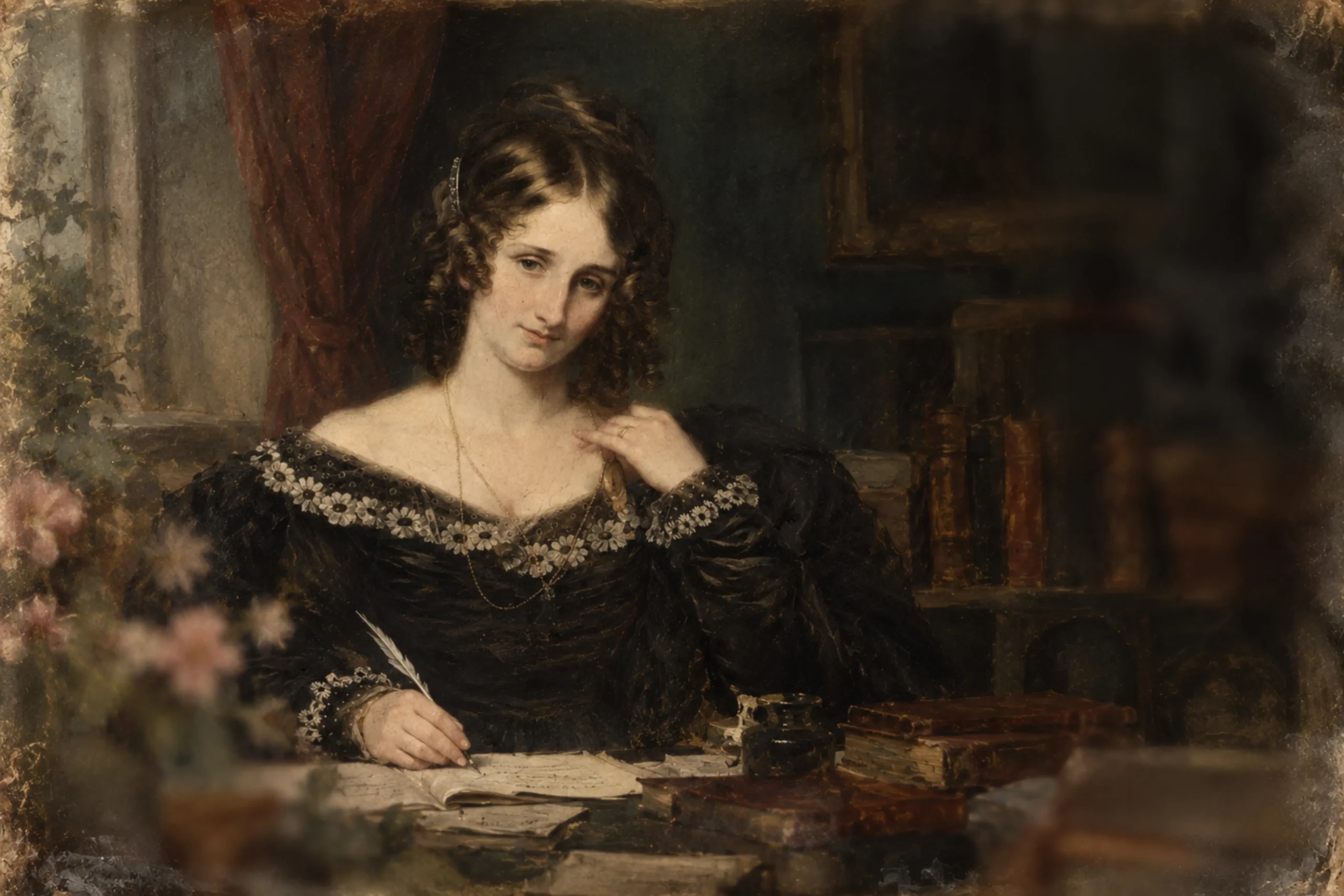
Mary Shelley: The Woman Behind Frankenstein
This post may contain affiliate links. As an Amazon Associate and Bookshop.org affiliate, I earn from qualifying purchases at no extra cost to you.
Table of Content
- She Was Born Into a Very Unusual Family
- Mary Shelley Was Writing Young
- The Summer That Gave Us Frankenstein
- But Frankenstein Isn’t Really About a Monster
- Mary Shelley Was Much More Than Frankenstein
- And Then There’s the Feminist Question
- A Few Mary Shelley Facts You Might Not Know
- Why I Keep Coming Back to Frankenstein
- Keep Exploring
- FAQs About Mary Shelley
If you’ve been around The Reader Life for more than five minutes, you probably know I have a serious soft spot for Frankenstein. I love this book. The story, the atmosphere, the creature, the questions it refuses to answer neatly—it has stayed with me in a way that many supposedly “scary” books simply don’t.
So naturally, when we’re doing Halloween at The Reader Life, I couldn’t resist bringing Mary Shelley into the conversation.
But here’s the thing: Mary Shelley is so often reduced to a single sentence: the woman who wrote Frankenstein. But behind that famous book was a remarkably unconventional life, one filled with intellectual rebellion, love, loss, scandal, and enough tragedy to rival some of her fiction.
She Was Born Into a Very Unusual Family
Mary Wollstonecraft Shelley was born on August 30, 1797, in London. Her parents were two of the most intellectually radical people of their generation: philosopher and novelist William Godwin and writer and feminist thinker Mary Wollstonecraft, whose A Vindication of the Rights of Woman had argued for women’s education and intellectual independence.
There is one particularly sad irony here. Mary Wollstonecraft died from complications following Mary’s birth just eleven days later. So Mary grew up without the mother whose ideas would become part of her intellectual inheritance. She did, however, grow up surrounded by books and ideas. Her father’s household was filled with literary and political figures, and she had access to Godwin’s extensive library.
In other words, Mary didn’t exactly grow up in a house where someone was going to tell her that girls should stick to embroidery and leave the thinking to the men. Although society at large was still very much trying to make that happen.
Mary Shelley Was Writing Young
Mary’s literary ambitions appeared early.
As a child, she wrote stories and poetry, and by the age of eleven she had even published a little rhymed children’s tale through the publishing house associated with her family. Later, her time in Scotland gave her space away from the complicated atmosphere of her father’s household and became important to the development of her imagination.
Then came Percy Bysshe Shelley. What a poet!
We look before and after,
And pine for what is not:
Our sincerest laughter
With some pain is fraught;
Our sweetest songs are those that tell
Of saddest thought. – To A Skylark
Anyway, Mary met the poet when she was sixteen, while he was already married. In 1814, the two eloped to continental Europe with Mary’s stepsister Claire Clairmont. The trip was romantic, financially disastrous, and eventually forced the young couple back to England.
It is worth pausing here because Mary’s life does not fit neatly into the image of the quiet Victorian woman waiting patiently for respectable domesticity. She ran away with a married man. She lived outside the conventional expectations of marriage before eventually marrying him. She travelled, wrote, published, and argued with people.
And she did all of this while living in a period when a woman’s reputation could be damaged very easily by doing things that men could get away with rather more comfortably. The feminist context matters here.
Mary had inherited her mother’s radical intellectual legacy, but she was still living in a society that gave women considerably fewer educational, professional, financial, and social freedoms than men. Her life was full of contradictions: she was intellectually ambitious and surrounded by radical thinkers, yet she was also financially dependent on men and repeatedly had to negotiate the restrictions placed on her because she was a woman.
And then, in the summer of 1816, everything changed.
The Summer That Gave Us Frankenstein
In 1816, Mary, Percy Shelley, Claire Clairmont, Lord Byron, and physician John Polidori were staying near Lake Geneva.
The weather was unusually cold and gloomy that summer, and the group spent long evenings indoors talking, reading, and discussing German ghost stories. Then Byron suggested a challenge: Everyone should write a ghost story.
Mary struggled with an idea at first, and then she had a waking dream. In her own later account, she described imagining a young scientist bringing a creature to life and becoming horrified by what he had created. That idea eventually became Frankenstein; or, The Modern Prometheus. And I still love the absurdity of this origin story.
A group of famous Romantic writers are sitting around trying to frighten each other, and Mary Shelley basically goes: Fine. I’ll invent an entirely new kind of nightmare. She was just eighteen!
By 1817, she had completed the manuscript, and Frankenstein was published in 1818. The first edition appeared anonymously, which meant readers initially had no idea that the author was a young woman. And honestly, imagine being eighteen, writing one of the most influential novels in English literature, and then having the world read it without even knowing your name.
But Frankenstein Isn’t Really About a Monster
This is one of the reasons I love the book so much.
Yes, there is a creature made from dead bodies. Yes, there is a scientist who makes an absolutely catastrophic decision. But the novel is really interested in creation, abandonment, loneliness, responsibility, ambition, prejudice, and what happens when someone creates life without accepting responsibility for the life they’ve created.
And that makes the story particularly interesting when you remember who wrote it.
Mary had lost her own mother almost immediately after being born. She experienced pregnancy, childbirth, the deaths of children, and the pressures of motherhood herself. Her life gives the novel’s obsession with birth, creation, parental responsibility, and abandonment an especially interesting context—even though we should be careful not to reduce the novel to an autobiography.
The Creature isn’t frightening simply because of the way he looks. In fact, Shelley describes him as beautiful when he first comes to life. What makes him terrifying is everything that happens afterwards: he is created, rejected, left completely alone, and denied the companionship he desperately wants. And that, to me, is what makes him such a sad and memorable kind of monster.
Mary Shelley Was Much More Than Frankenstein
Here’s another thing I wish we talked about more.
Mary Shelley did not write Frankenstein and then disappear into literary history. She wrote several other novels, including Valperga, The Last Man, Lodore, Falkner, and The Fortunes of Perkin Warbeck. She also wrote travel literature, biographies, essays, and other nonfiction. She also became an important editor of Percy Shelley’s work after his death.
When Percy drowned in 1822, Mary was left widowed with her surviving son, Percy Florence. She spent years preserving and editing Percy’s writings, despite restrictions imposed by his father, Sir Timothy Shelley, who controlled much of the family’s financial support. Eventually, Mary produced major editions of Percy’s poetry and prose.
So there is another slightly frustrating chapter in Mary’s story: even after becoming famous in her own right, part of her later literary life involved preserving a man’s literary legacy. And yet she kept writing her own books. She kept working, publishing, and building a literary life of her own.
And Then There’s the Feminist Question
I don’t think we need to turn Mary Shelley into a modern feminist icon to recognize how fascinating her position was. She was the daughter of Mary Wollstonecraft, whose writing challenged the idea that women should be educated merely to become attractive, obedient wives. Wollstonecraft argued for women’s intellectual development and independence at a time when those ideas were deeply controversial.
Mary inherited that intellectual environment, but she lived within a world that still placed enormous restrictions on women. Even her authorship became something people had to negotiate.
Frankenstein was initially anonymous. Percy Shelley helped edit the manuscript, and scholars continue to debate the extent of his contribution, but the novel is Mary’s work and her name eventually became inseparable from it. And perhaps one of the most interesting things about Mary is that she didn’t need to loudly announce herself as a revolutionary woman writer for her life to be unconventional.
She simply kept writing. And I think there’s something powerful in that. She didn’t need a grand feminist speech to make a point about women’s place in society. She had ideas, she had stories to tell, and she kept putting them on the page even when the world around her wasn’t exactly encouraging women to take up intellectual space.
A Few Mary Shelley Facts You Might Not Know
Because no Info-Bite should leave without a few little literary rabbit holes:
- She was only eighteen when she conceived the idea that became Frankenstein. The novel was published when she was twenty.
- She wasn’t simply “Percy Shelley’s wife.” She became a successful novelist, travel writer, biographer, editor, and literary figure in her own right.
- Her first daughter was born prematurely in 1815 and died shortly afterward. Mary later experienced the deaths of two more young children before her surviving son, Percy Florence, was born in 1819.
- Frankenstein became hugely popular on stage soon after publication. Mary attended one of the early adaptations and famously described her reaction as essentially discovering that she had become famous.
- Mary later wrote The Last Man, a novel about a future devastated by plague. It was published in 1826, decades before the modern popularity of pandemic fiction.
- Her final years were quieter, but she continued writing and travelling. Her last book, Rambles in Germany and Italy, appeared in 1844. She died in London in 1851, aged fifty-three.
Why I Keep Coming Back to Frankenstein
I think this is probably the part where I should admit that I really, really love Frankenstein. The book is a perfect classic and yes quite perfect for spooky season right now; I actually recommended it in my 9 Halloween Books To Read This Month!
But also, I love that every time you return to it, the Creature seems to raise a slightly different question. Who is the real monster? The person who creates life and abandons it? The society that refuses to see the humanity in something frightening? The Creature himself? Or perhaps the entire idea that we can create something without considering what we owe it afterwards?
Mary Shelley gives you the monster, but then she makes you sit with him. And suddenly the scary story becomes something much more uncomfortable, and much more human. That is probably why Frankenstein has survived for more than two centuries while so many other Gothic stories have faded away.
Mary Shelley didn’t just create a monster. She created a question we still haven’t finished answering. And just a friendly suggestion (because I know more than half of you are thinking about how we created AI and stopped taking responsibility for it), if you want to explore the same question in a modern story, Annie Bot is a very good read!
Keep Exploring
And if you enjoyed this little dive into Mary Shelley’s life, there are plenty more literary rabbit holes where that came from, because this writer loves looking beyond the book and into the people, ideas, and strange stories behind the literature we keep returning to.
So if you’re in the mood for another literary curiosity, have a look around The Reader Life, you never quite know which writer, book, or forgotten story you’ll fall into next.