Heart the Lover by Lily King Review: Love, Memory, and the Lives We Don’t Live
This post may contain affiliate links. As an Amazon Associate and Bookshop.org affiliate, I earn from qualifying purchases at no extra cost to you.
Table of Content
Book Snapshot
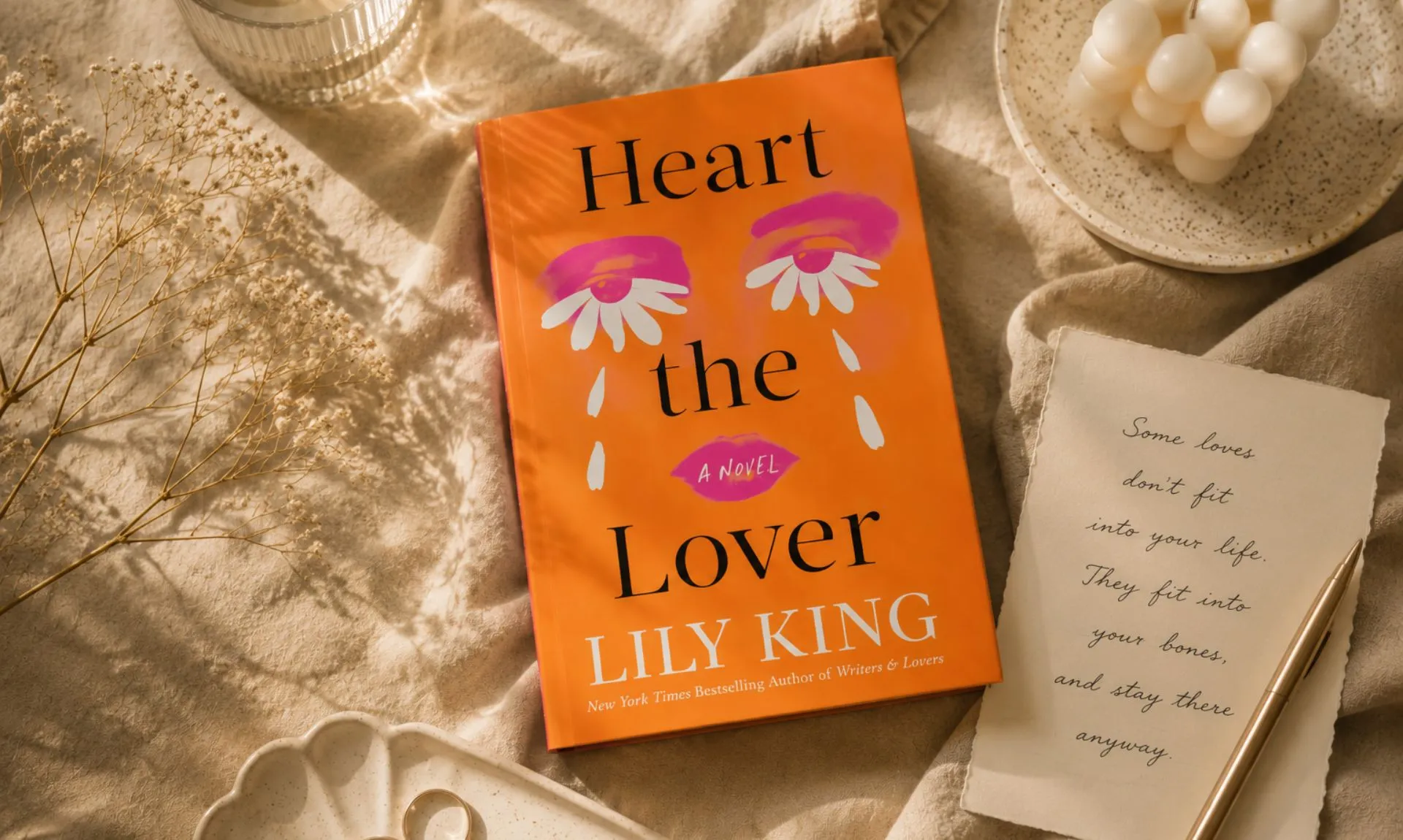
Title: Heart the Lover
Author: Lily King
Genre: Literary Fiction
I need time to recover from this tale of love and loss. It completely wrecked me. If I could give this novel more than five stars, I honestly would.
Heart the Lover is one of the most beautiful and tragic literary fiction romances mainly because of the way it’s written. Lily King has a remarkable way of storytelling. The structure moves across decades, school years with Casey, Sam, and Yash, then twenty-one years later when Yash returns to see her again, and finally the last section as the three of them reunite, each bearing their unique pain. The time shifts don’t fragment the story. They deepen it.
It really makes you see what happens when you don’t live the life you have always wanted. It’s tender and heartbreaking all at once.
Although it is supposed to be a love story, King never romanticizes the tale. She understands that real heartbreak often looks ordinary. People move away. Years pass. Marriages happen. Bodies age. Life keeps unfolding. And yet some part of us remains emotionally tethered to another person anyway. That emotional honesty is what made this novel unforgettable for me.
If you enjoy emotionally intimate literary fiction about complicated relationships and the lives we almost lived, you might also like my review of Normal People, another novel that explores love, uncertainty, and adulthood in a very different but equally affecting way.
What This Story Feels Like
Heart the Lover is not a dramatic tale of love and romance. The love triangle is intense, but it is portrayed with such tenderness that you don’t really feel that rush of emotions that’s the hallmark of such twisted love stories.
Despite the emotional intensity, it has a very calm and serene vibe to it, but its impact lasts way longer. It is beautiful, but it is very heartbreaking. It is the sort of book that deeply affects you without deliberately trying for it.
The story is quite simple. Our narrator, Casey (called Jordan for most of the book), falls in love with Sam. However, she develops a very sweet connection with his best friend, Yash. The school years test their relationship, and Sam and Casey keep breaking up and coming back to each other, over and over again. Later, Casey and Yash finally fall in love, but their love is doomed from the beginning, not because they are the cursed characters from Greek tragedy, but simply because that’s how life is for most of us.
The story starts as her reflection as she looks back at the friendships and love relationships that have shaped her life, especially her relationship with Yash and Sam. It has one of the loveliest openings:
“You knew I’d write a book about you someday. […] I’ll never know how you’d tell it. For me it begins here. Like this.” (p. 1)
Lily King explores first love by reflecting on the hostile nature of time that does not wait for anyone, does not grant second chances, and slips from our hands like a slithery serpent: deadly but beautiful. It is about the tricks of life, how we almost choose the right people, lose them, and still carry a part of them. It is a tale about the lives that continue even when some essential and dire yearning remains…unfulfilled.
The Structure That Makes the Novel Work So Beautifully (Spoiler-Alert)
One of the most striking things about this novel is its structure. The story unfolds across three emotional time layers:
- the school years with Casey, Sam, and Yash
- Casey and Yash’s reunion more than two decades later
- and the final chapter as Yash faces the end of his life
Instead of moving forward chronologically, the novel moves through memory. At one point, Casey reflects on a philosophical idea that quietly explains the structure itself:
“the belief that everything that is, has been, and will be, exists right now and forever, all at once.” (p. 180)
And then the opposite idea:
“the belief that only what exists in the present exists at all. Nothing before and nothing after.” (p. 180)
By the end she returns to this question again:
“Maybe it’s true what the philosopher said, that the past and the future don’t exist, that this is the only moment we ever have, this moment right now and this moment and this – ” (p. 187)
The novel itself seems to live inside that tension. Everything exists at once. And yet only the present moment matters.
If you prefer audiobooks, great news! Audible has it for free. Just opt for the free trial and have fun listening! Though you might be crying for the most part.
Casey Is Jordan, Not Daisy
One of my favorite details in the novel is that we don’t learn Jordan’s real name, Casey, until the final sentence. And that detail feels intentional. She is named after Jordan Baker from The Great Gatsby, not Daisy.
She is described as:
“the kind of girl you divorce” (p. 49)
That line explains everything. Casey is not written as a romantic ideal. She appears submissive in the beginning, but she is actually quite perceptive and opinionated, sometimes rash, deeply passionate, and entirely her own person. She made me think of Othello when he said:
“I am one who loved not wisely, but too well.” (Act V)
The love between Casey and Yash is intense, but it’s not always wise, and that’s what causes the irreversible tragedy. Despite the tragic arc in her character, Casey is not pitiable. She leaves when she needs to leave. She stays when she chooses to stay. She refuses to become someone else’s story, and as a reader, you witness this transformation.
Love That Is Intellectual, Not Just Emotional
One of the reasons Casey and Yash feel so connected is that their relationship isn’t only romantic. It’s intellectual companionship.
She describes it like this:
“We don’t just have s*x. We read The Aneneid out loud to each other. We read Yeats and Auden. We read Proust in French because we both studied it in high school and we talk about moving to Paris.” (p. 69)
That kind of closeness makes their separation feel less dramatic, but more heartbreaking. It’s not that they stop loving each other. It’s that life keeps happening around them.

The Tragedy Is Real &… Absurd
At one point, Yash describes life itself like this:
“Ofcourse it’s a tragedy. A very silly one. The absurdity is as great as the despair.” (p. 59)
That sentence feels like the emotional key to the entire novel. Nothing separates them in one single moment. There is no dramatic turning point. Instead, their lives unfold in ways that slowly move them apart.
Despite the tragedy, their love for each other never diminishes. It has a persistent presence in their lives. One of the most moving sections of the novel is when Yash returns to visit her after twenty-one years. She thinks:
“It’s so strange you’re here, and so unnerving how familiar you are, the rhythm of your voice, the tilt of your head, the shifts of your body, the hair on your wrists, the scar on your lip” (p. 105)
Later she reflects:
“You have your regrets and I have mine. I sit on the porch step for a while, thinking about life’s tricks, the ones we see, the ones we don’t.” (p. 119)
And Sam tells her something that reshapes how we understand their past:
“I don’t know the whole story, but since the moment he met you, I knew he would have done anything for you.” (p. 169)
By this point, it becomes clear that what separated them was never simple; they could never have pointed it out. It was simply life unfolding and playing its tricks.
A Love That Exists Across Decades
Heart the Lover presents a love that has an undeniably strong presence. Yash is not part of Casey’s life, but he exists in her heart, with her all the time, no matter what. At one moment, Casey realizes:
“If he knew how much I loved him it would terrify him.” (p. 97)
And near the end she tells him:
“I have loved you all my life…See you after the next bang.” (p. 183)
It’s one of the quietest and most devastating lines in the novel, because it explains everything. They have always loved each other, despite everything. They just didn’t get the chance to live the life they had always wanted and intended.
But more than that, Lily King presents love in all its shades and hues. Casey is a mother, and she loves her sons. Yash’s meeting with her sons is so tender and sweet. Silas’s connection with Yash is very mature and respectful. Love is thus a very widely presented idea in the book, and it is not confined to its traditional connotations.
Silas and the Life That Still Matters (Spoiler Warning)
Silas is not written as a consolation prize. He is a genuinely good choice for Casey. He is a good husband and a very good father. He represents stability, partnership, and the life she builds in the present. But he is not Yash. And the novel never pretends otherwise.
Instead, it suggests something more honest: we can fall in love more than one time in our lives. But yes, the intensity and the connection vary. Some loves shape us permanently despite being absent, others become part of our present life and act as a soothing ointment that heals our past wounds. And both can be real at the same time.
This tension is what makes the ending feel so quietly devastating rather than dramatic.
Why This Novel Feels So Real
The narrative in Heart the Lover is one of the main reasons that makes it highly believable and real. Lily King makes sure that her ideas never drift apart from real human feelings. Casey, as a narrator, shares relatable and raw human emotions. At one point, she says while referring to Sam:
“I’ve noticed that about people who had stable childhoods. They like to create their own problems.” (p. 28)
The novel has such poignant reality-checks scattered all over the narrative. The love connection between Casey and Yash, the friendship between Yash and Sam, the characters and their interactions with their families, everything feels relatable and extremely real.
Lily King explores the psychological depth of her characters, which adds literary appeal to the story. There is a kind of psychological clarity that runs throughout the novel, and even when the story moves through decades, friendships, marriages, illness, and regret, it never becomes exaggerated.
Instead, it feels recognizably human. It’s messy, unfinished, and completely believable.
A Quiet Companion to “Sad Girl Literature”
If you’ve noticed how many readers are returning to introspective novels about memory, identity, and emotional uncertainty lately, this book fits beautifully into that larger trend. I wrote more about this shift in my post on sad girl literature as a viral reading trend.
You might also find an interesting contrast in Annie Bot, which explores connection and autonomy in the backdrop of modern technological trends.

Is Heart the Lover Worth Reading?
Absolutely. This is the type of book I would sell my soul to read for the first time again!
It is perfect for everyone, but especially if you enjoy literary fiction romance like Normal People, that explore love not as a single event, but as something that changes shape across time.
This is a story about first love. But it’s also a story about memory, timing, and the lives we build even when part of us remains somewhere else. If you enjoy reflective literary fiction like this, there’s much more waiting for you on The Reader Life.