Elena Knows Review | The Saddest Mystery Is How Little We Know the People We Love
This post may contain affiliate links. As an Amazon Associate affiliate, I earn from qualifying purchases at no extra cost to you.
Table of Content
Book Snapshot
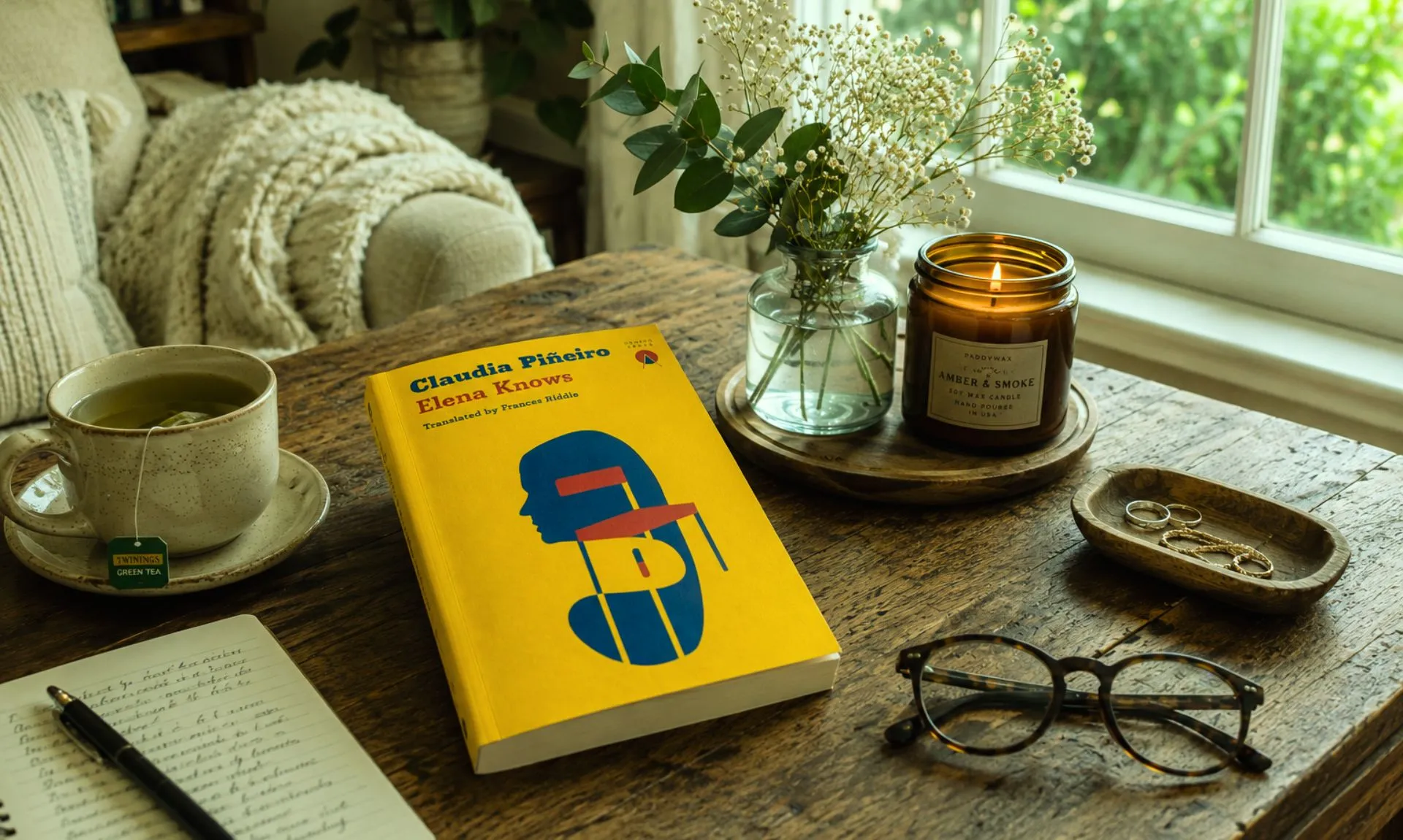
Title: Elena Knows
Author: Claudia Piñeiro
Genre: Literary Fiction / Mystery
Pages: 176
Best For: Readers who enjoy literary fiction, character-driven mysteries, and morally complex stories.
I went into Elena Knows expecting a literary mystery. I came out of it thinking about motherhood, religion, bodily autonomy, chronic illness, and the uncomfortable possibility that loving someone deeply does not necessarily mean understanding them.
At just over 150 pages, Claudia Piñeiro’s Elena Knows is a remarkably short novel. Yet somehow it manages to tackle more difficult questions than books three times its length. It is the kind of story that quietly slips under your skin and stays there long after you’ve finished the final page. Not because it was enjoyable in the traditional sense. In fact, there were moments when it was emotionally exhausting. But it was also one of the most thought-provoking books I have read in a long time.
If you are a contemporary fiction fan, my guide on accessing FREE contemporary books will be really helpful for you!
A Spoiler-Free Summary
The novel opens with the death of Rita, Elena’s only daughter. Authorities have ruled it a suicide but Elena refuses to believe them.
Rita was found hanging from a church bell tower on a stormy day, and Elena is convinced that her daughter would never have climbed that tower voluntarily. Determined to prove that Rita was murdered, she embarks on a difficult journey to meet a woman named Isabel, whom Rita once helped years earlier.
What follows is part mystery, part character study, and part meditation on illness, grief, and certainty.
The plot itself is compelling, but what truly makes Elena Knows stand out is its narrative voice. Much of the novel feels like being trapped inside Elena’s thoughts. Her observations, assumptions, frustrations, and certainties shape everything we see.
And that becomes incredibly important as the story unfolds.
The Most Powerful Representation of Parkinson’s Disease I Have Read
Before reading this book, I knew very little about Parkinson’s disease. I understood the basics, but I had never encountered a literary portrayal that made me feel the daily reality of living with it.
Piñeiro does not romanticize Elena’s condition. She presents it in a way that is raw, frustrating, and deeply human. One passage in particular perfectly captures the disconnect Elena feels between her mind and her body:
“And her brain is nothing, she thinks, because her feet don’t listen to it. Like a dethroned king who doesn’t realise he’s not in charge anymore.” (p. 13)
The motif of the dethroned king reappears throughout the novel, each time with more emotional intensity.
Elena’s body constantly betrays her. Every movement must be planned around medication schedules. Every journey becomes an obstacle course. Tasks that most people complete without thinking require immense effort and concentration.
What makes the portrayal especially heartbreaking is that Elena’s mind remains sharp. She notices everything. She thinks constantly. Yet her body refuses to cooperate. The novel conveys this reality in simple yet devastating sentences:
“But sometimes, Elena knows, trying hard isn’t enough.” (p. 55)
A Novel About Death That Refuses Easy Answers
Although the mystery drives the story forward, death lingers over every page.
Rita’s absence is felt constantly, particularly in the small details. One of my favorite passages occurs when Elena is dealing with her daughter’s belongings:
“Clothes always retain a person’s smell, Elena knows, even if they’re washed a thousand times with different detergents.” (p. 22)
It is such a simple observation, yet anyone who has lost someone will immediately understand what it means.
The novel also contains surprisingly philosophical reflections on death. At one point Elena thinks:
“If so many people believe that we are all dust and to dust must turn again, why delay the return. They pick fancy caskets just to show off, she thinks, why would they do it otherwise, if they know neither the coffin nor what’s inside it are destined to last but to rot, to be eaten by worms, both the wood and that body that no longer belongs to anyone, like an empty bag, incomplete, a pod without seeds.” (p. 44)
And later:
“she knows there’s no coming back from death, whether she’s placed in an oak coffin or one made of balsa wood, no matter who hears her prayers or whether the one hearing her prayers even exists, whether the entire neighbourhood weeps for her dead daughter or no one weeps at all, there’s no possible return.” (p. 48)
What I appreciated most was that the novel never tries to soften death or make it comforting. It simply makes the reader confront it.

The Real Mystery
At first, the mystery appears straightforward.
Did Rita kill herself? Or was she murdered?
But somewhere around the middle of the novel, I realized that I had become interested in a completely different question.
Does Elena actually know Rita as well as she believes she does?
The title itself begins to feel ironic.
Throughout the novel, Elena insists that she knows her daughter better than anyone else. She knows what Rita would do. She knows what Rita would never do. She knows what happened. You keep reading Elena knows, Elena knows, and Elena knows… And because we spend so much time inside Elena’s head, we are inclined to believe her.
Until the cracks begin to appear. The more memories emerge, the more complicated their relationship becomes. What initially appears to be devotion gradually reveals traces of control, expectation, and emotional burden. And suddenly the mystery is no longer about Rita’s death. It becomes about whether one person can ever fully know another.
Spoiler Discussion

Warning: Major spoilers ahead.
The conversation between Elena and Isabel was easily my favorite part of the entire book. I expected a revelation about the murder. What I got instead was something far more interesting.
For years, Elena and Rita viewed themselves as people who had “saved” Isabel from having an abortion. From their perspective, they had protected a life. But Isabel tells a very different story. She reveals that she never wanted the child. Her husband was gay. Her marriage was already falling apart. She did not want to become a mother.
Yet everyone around her insisted that motherhood was what she should want. As Isabel puts it:
“all the people who say they know what they’re talking about, insist that a mother should want to be a mother.” (p. 134)
That line perfectly captures one of the novel’s central themes. The assumption that society always knows what is best for women. The assumption that motherhood is inherently fulfilling. The assumption that sacrifice is always noble.
For perhaps the first time in the novel, Elena is confronted by someone who refuses to accept her certainty. And Isabel does not stop there.
When Elena insists that Rita could never have climbed the church tower in the rain because she was afraid of storms, Isabel responds:
“Never isn’t a word that applies to our species, there are so many things that we think we’d never do and yet, when put in the situation, we do them.” (p. 135)
That single statement completely reframes the novel. Because by that point I had started wondering whether Rita might have done absolutely anything to escape the life she was trapped in, even if she had to commit things that Elena believed she would never do.
Another powerful moment comes when Isabel says:
“You can imagine the pain, the guilt, the shame, the humiliation. But you only know something once you’ve experienced it in your life, life is our greatest test.” (p. 136)
And suddenly the title gains yet another layer.
Elena knows many things, but there are also things she cannot know. There are experiences she never lived, choices she never had to make, and pain she never carried.
By the end, I found myself questioning whether Rita’s death was the novel’s true mystery at all.
The real mystery may have been the distance between a mother and daughter who loved each other deeply yet never fully understood one another.
If emotionally heavy stories are your thing, you might also enjoy my list of devastating books that completely broke my heart.
Final Thoughts
Elena Knows is not an easy book. It is sad, emotionally draining, and at times, genuinely uncomfortable.
Watching the relationship between Elena and Rita slowly unravel through memories was one of the hardest parts of the reading experience for me.
Yet it is also what made the novel so memorable.
Claudia Piñeiro takes topics that many authors would avoid; she discusses Parkinson’s disease, reproductive rights, religious rigidity, caregiving, aging, guilt, and autonomy, and examines them with remarkable honesty.
This is a small novel carrying very heavy questions…Questions about how well we know the people we love, about who gets to make choices about their own lives, and about certainty and whether it can sometimes become a form of blindness. And perhaps most importantly, questions about whether love alone is enough to truly understand another person.
If you enjoy literary fiction that prioritizes character, moral complexity, and difficult conversations over action-packed plots, Elena Knows is absolutely worth your time. It may be short, but it carries the weight of a much larger novel.
If you enjoy my writing, there’s a lot for you on The Reader Life, including book reviews, recommendations, and literary discussions posted weekly. Thank you for your time. Have a good day.