
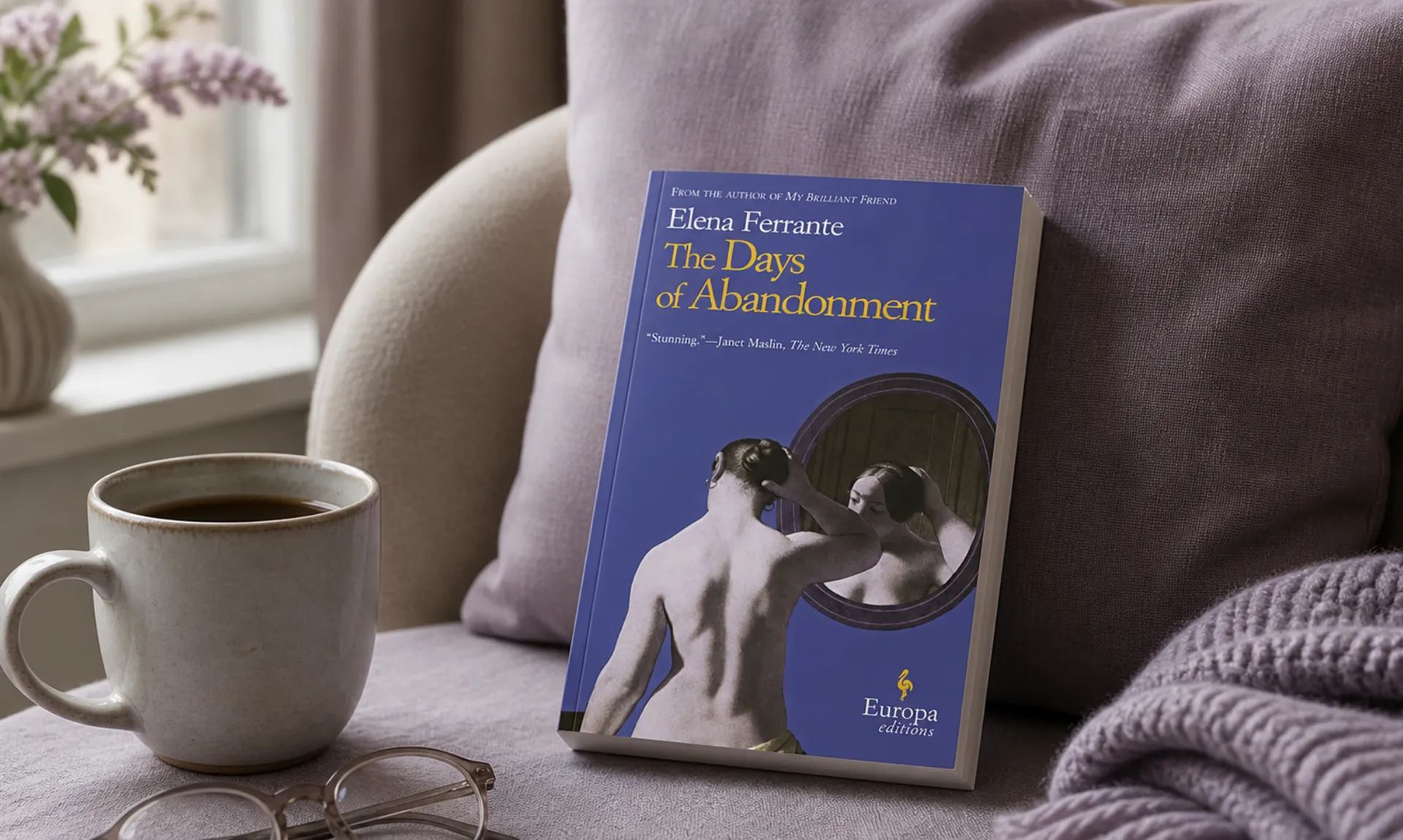
The Days of Abandonment Book Review: Elena Ferrante’s Portrait of a Woman Unraveling
This post may contain affiliate links. As an Amazon Associate and Bookshop.org affiliate, I earn from qualifying purchases at no extra cost to you.
Table of Content
Book Snapshot
Title: The Days of Abandonment
Author: Elena Ferrante
Genre: Literary Fiction, Psychological Fiction
Best for: Readers who enjoy emotionally intense literary fiction, complicated female characters, and deeply psychological stories about marriage, motherhood, identity, and heartbreak.
There are sad books, and then there are books that make you feel as though you’re standing helplessly in the corner of a room, watching someone slowly fall apart. You can’t intervene, you can’t look away, and all you can do is witness the misery, the grief, and the sheer agony unfolding in front of you. That is exactly what The Days of Abandonment by Elena Ferrante felt like to me.
The novel begins with one of the most poignant opening lines:
“One April afternoon, right after lunch, my husband announced that he wanted to leave me. He did it while we were clearing the table; the children were quarreling as usual in the next room, the dog was dreaming, growling beside radiator.” (p. 4)
That’s it. No elaborate setup or warning. Just a casual family dinner and boom!
Anyway, the novel itself is quite simple. Olga is 38 years old, married to Mario, and they have two children, Gianni and Ilaria, along with their dog, Otto. Then Mario tells her he is leaving. For a younger woman, Carla. And just like that, the life Olga thought she knew begins to collapse.
What follows is not really a story about a woman getting over a breakup. It is a story about what happens when abandonment tears open everything you have spent years trying not to look at. And Ferrante takes her time showing us every ugly, painful part of it.
If you enjoy tragic feminist narratives, I’ve also reviewed Kate Chopin’s The Awakening, which I think you’d love if you’re in the mood for a classic with a similar feel.
A Marriage Ends, But Olga’s Life Doesn’t Know How to Continue
Spoilers Ahead!
When Mario leaves, Olga doesn’t simply lose her husband. She loses the structure around which her adult life has been built. She had been married for fifteen years. She had children. She had a home. She had given up parts of herself to accommodate the family she had built, and, most painfully, she had put aside her own writing ambitions. There is a particularly painful realization Olga has about this:
“It seemed to me incredible that all of a sudden he had become uninterested in my life, like a plant watered for years that is abruptly allowed to die of drought.” (p. 17)
That image is devastating because it captures how suddenly abandonment can make years of intimacy feel meaningless. For fifteen years, Olga had been part of Mario’s life, and then he simply stopped tending to that relationship. To him, perhaps, the marriage had run its course. To Olga, it feels like someone has suddenly decided that something they spent years nurturing is no longer worth keeping alive.
And that’s only the beginning of her grief. She eventually recognizes just how difficult she has become to herself:
“It was difficult to put up with me. I found myself alone and frightened by my own desperation.” (p. 24)
I love the honesty of this. Olga isn’t only grieving Mario. She is also watching herself change and realizing that she has become someone she doesn’t entirely recognize. She is frightened by her own desperation, and Elena Ferrante doesn’t give her an easy way out of it.
The Life Olga Gave Up Comes Rushing Back
One of the most interesting parts of Olga’s despair is that Mario isn’t the only thing she has lost. There is also the woman she might have been. Before marriage and motherhood, Olga had ambitions as a writer. But somewhere along the way, those ambitions were pushed aside.
And now, after Mario leaves, she has all this time to think about what she sacrificed, which is almost cruel, because suddenly the life she had given up isn’t dead. It’s sitting there in her memory, asking what might have happened if she had chosen differently. At one point, Olga thinks about how much of her own life she had surrendered:
“Why had he so casually thrown away fifteen years of feelings, emotions, love? He had taken for himself time, time, all time of my life, only to toss is out with the carelessness of a whim.” (p. 29)
That sense of stolen time runs through so much of the novel, and then Ferrante takes it even further:
“I had taken away my own time and added it to his to make him more powerful. I had put aside my own aspirations to go along with his. At every crisis of despair I had set aside my own cries to comfort him, I had disappeared into his minutes, into his hours, so that he could concentrate.” (p. 65)
This was one of the passages that really stayed with me, because suddenly the breakup isn’t simply my husband left me. It becomes: What did I give up to build this marriage? And perhaps even more painfully: Who would I have been if I hadn’t?
That is where The Days of Abandonment becomes much more than a story about divorce. It is also about the terrifying realization that you may have participated in your own disappearance. Olga doesn’t only have to ask, Why did Mario leave me? She also has to confront the loss of her own identity.
If you enjoy exploring identity crises from a feminine perspective, Sierra Greer’s Annie Bot and Madeleine Gray’s Green Dot are both worth picking up. They capture that same unsettling feeling of what can happen when you give too much of yourself to a man and slowly lose sight of who you are.
Ferrante Doesn’t Make Olga’s Grief Pretty
This is probably the thing I found most striking about the novel. Ferrante doesn’t give us an elegant version of female heartbreak. Olga is not sitting beautifully by a window, drinking wine and reflecting on lost love.
She is furious, jealous, and humiliated. We find her frustrated, and she drags the reader deep into her disturbing thoughts. She resents her children. She thinks about her sagging body. She thinks about Mario and his young lover Carla. She thinks about the years she lost, and sometimes she behaves in ways that are genuinely difficult to watch (or read about). It is messy because grief is messy.
There is another moment where Olga seems to resist the idea that abandonment has completely destroyed her:
“I was not the woman who breaks into pieces under the blows of abandonment and absence, who goes mad, who dies. Only a few fragments had splintered off, for the rest I was well, I was whole, whole I would remain.” (p. 77)
There is something almost heartbreaking about that insistence. She is trying to tell herself that she is still whole while we can clearly see how badly she is struggling. It is almost as though Ferrante takes the idea of a woman “falling apart” and refuses to keep it metaphorical.
Olga unravels psychologically, emotionally, physically, and even domestically. Her house becomes a reflection of her mind. Her relationship with her children becomes strained. Her thoughts become increasingly obsessive. And the further she goes, the more claustrophobic the book becomes.
The Weight of Being Olga
One of the strangest things about the novel is how Elena Ferrante turns Olga’s emotional suffering into something almost physical. She isn’t simply sad. Being herself becomes exhausting. At one point, she describes the effort of simply holding herself up:
“I pulled myself up with an effort of will, I lifted a weight that I hadn’t enough strength for. I couldn’t seem to take in the fact that it was I myself weighing on me, I weighed more than lead. I had no desire to hold myself up for the whole day.” (p. 92)
That is such a good description of depression and despair, not necessarily because it explains them, but because it makes them feel physical. Olga herself is the weight she has to carry, and there is nowhere she can put it down.
And Then There Are the Children
If Olga’s grief is suffocating, her children don’t exactly make the situation easier. Gianni and Ilaria are not monsters. They’re children. They have their own fears, needs, frustrations, and ways of processing their parents’ separation. But they are also, at times, incredibly irritating, which, honestly, felt realistic.
Ilaria can be demanding, Gianni can be selfish, and Olga is trying to hold herself together while simultaneously being expected to remain a functioning mother. There is something particularly uncomfortable about watching Olga resent the demands of motherhood while knowing that she loves her children. Ferrante doesn’t neatly resolve that contradiction. And I’m glad she doesn’t, because motherhood can contain love and exhaustion at the same time.
You can adore your children and still desperately want five minutes where nobody needs anything from you. Olga’s worst moments with her children are uncomfortable precisely because they expose thoughts that mothers aren’t supposed to admit. At one point, Olga’s resentment becomes almost grotesque:
“I was like a lump of food that my children chewed without stopping; a cud made of a living material that continually amalgamated and softened its living substance to allow two greedy bloodsuckers to nourish themselves, leaving on me the odor and taste of their gastric juices.” (p. 94)
That is an absolutely brutal image. And yes, it is also rather shocking to see a mother describe her children this way. But I think that is exactly why it works.
Motherhood is often presented as an endless source of love and fulfillment, but Ferrante is interested in the other side of it too: the exhaustion, the loss of privacy, the feeling that your time and body belong to everyone except you. Olga loves her children, but she is also exhausted by them. Those things can exist together. And I appreciated that Ferrante doesn’t pretend otherwise.
The Day Everything Becomes Too Much
There is a section of the novel where Olga becomes physically trapped inside her home because of a problem with the door and the key. And this is where the novel becomes almost unbearably claustrophobic. She is already psychologically trapped. Now she is literally trapped too.
Her children are there. Gianni is sick. Otto is dying. Olga is exhausted and unraveling, and there is no easy escape from the situation. The phone is broken, the computer isn’t working, and every possible way of reaching the outside world seems to have suddenly disappeared. She is completely cut off, left alone with two children, a dying dog, and her own increasingly desperate mind.
The scenes in this section are quite brutal, with self-harm and self-loathing taken to an extreme level. And then Otto dies. Olga is in such a state that even something as devastating as losing the family dog becomes another thing she has to process while trapped inside the house. And yet, amid all that chaos, there is this sentence:
“Get moving again, right away, think of solutions. Avoid surrendering to the senselessness of the day, hold they fragments of life together as if they still had their allotted place in a design.” (p. 145)
For me, this is where something shifts in Olga. She is still a complete mess, and nothing is magically fixed, but she finally starts trying to deal with what is in front of her instead of getting swallowed by it. Get moving again. That becomes the real lesson for her, not getting Mario back or somehow returning to the woman she was before, but figuring out how to keep going when her old life is no longer there.
Maybe Olga Wasn’t Alive With Him Either
One of my favorite lines comes later:
“What a mistake, above all, it had been to believe that I couldn’t live without him, when for a long time I had not been at all certain that I was alive with him.” (p. 149)
And this is where the entire novel begins to make sense. Olga has spent so much time believing that Mario’s departure has destroyed her, but eventually she starts questioning whether she was actually living fully when he was there.
That’s a very different question. Maybe losing him didn’t destroy her life. Maybe it exposed how much of her life had already disappeared. And I think that’s one of the strongest things Ferrante does here. She doesn’t turn Mario into the sole villain and Olga into a completely innocent victim.
Instead, she makes us look at the entire structure of their marriage. The compromises. The resentments. The unequal sacrifices. The things left unsaid. The identity Olga surrendered. And the strange fact that a relationship can be deeply important to you while simultaneously making you feel like you’re disappearing inside it.
Ferrante’s Description of Marriage Is Brutally Good
There is another passage I kept thinking about:
“What a complex foamy mixture a couple is. Even if the relationship shatters and ends, it continues to act in secret pathways, it doesn’t die, it doesn’t want to die.” (p. 176)
This might be one of my favorite ideas in the entire book, because a marriage doesn’t simply disappear when someone walks out. The person may leave. The relationship may officially be over, but fifteen years of habits, memories, arguments, expectations, routines, compromises, and shared experiences don’t evaporate overnight.
They continue inside you. They influence how you think, how you remember, how you raise your children, how you see yourself, and how you understand love. That’s why Olga’s recovery can’t simply be about forgetting Mario. She has to untangle herself from him.
Carrano and the Strange Return of Intimacy
Then there is Carrano, Olga’s neighbor and a musician. Their relationship is strange, awkward, intimate, and at times difficult to know exactly what to make of. I don’t think Carrano is particularly important because he might represent some great new romantic love. He’s more interesting as part of Olga’s gradual return to the world.
For so long, Olga’s identity has been tied to being Mario’s wife and the mother of his children. Now there is another man, someone who sees her outside of that role. Their intimacy is uncomfortable in places, but I think that’s fitting. Olga isn’t magically transformed into a confident, liberated woman just because another man enters her life.
She is still Olga, wounded, confused, and trying to understand herself, but she is beginning to discover that there is a world outside Mario. And that makes the second half of the book a little easier to read too. The melancholy is still there, but it doesn’t feel quite as suffocating as it did in the beginning.
The Children Start Moving Between Two Worlds
Eventually, Mario begins seeing the children more regularly, and they start spending weekends with him and Carla. And Olga gets something she desperately needs: relief.
For the first time, she has space to breathe, but there is another painful reality she has to face. The children start becoming comfortable with Mario and Carla. They build their own relationship with them. And, inevitably, they notice that there are things they like about that household. That has to hurt Olga. She has spent years sacrificing herself for her children, and now they can walk into another household and happily adapt to it.
But again, Ferrante doesn’t make the children villains. They are children. They don’t understand their mother’s sacrifices in the same way she does. They aren’t keeping a ledger of everything Olga gave up. They just want to feel safe and happy, and they don’t really understand everything Olga has given up for them. Perhaps that is part of what Olga has to learn too: being a good mother does not mean her children will always recognize or appreciate the sacrifices she has made for them.
The Bleakness of the Setting Works
I also really liked the way Ferrante uses the setting. The Italian setting isn’t treated like some postcard version of Italy. There is very little romanticizing here. The home feels closed in. The neighborhood feels intimate and claustrophobic. The ordinary domestic details become strangely oppressive.
And because so much of the novel takes place within Olga’s immediate world, everything feels increasingly narrow as her mental state deteriorates, that worked particularly well for me. The physical surroundings almost seem to shrink along with her world.
And Ferrante is very good at making ordinary things feel significant: a door, a key, a room, a child’s behavior, a dog lying beside the radiator. The novel begins with an ordinary afternoon, then that ordinary life becomes unbearable. Nothing about the world has changed, only Olga’s place inside it has! So yes, there is a peculiar bleakness to the setting that surrounds Olga.
One Big Problem With The Days of Abandonment
For all the things I admired about The Days of Abandonment, I also found it repetitive and exhausting. And not just because the subject matter is depressing.
The narrative itself sometimes circles the same emotions repeatedly. Olga thinks about Mario. Then she thinks about Mario again. Then she thinks about what she gave up. Then she thinks about Mario. Then she thinks about Carla. Then she thinks about her marriage. Then back to Mario.
I understand what Ferrante is doing. She is exploring the mind of a woman who is unravelling under the weight of abandonment. So yes, I think the repetition is partly the point. Grief is repetitive. Obsession is repetitive. When something has taken over your mind, you don’t think about it once and move on. You revisit it from ten different directions, looking for an explanation that probably doesn’t exist.
So in that sense, the narrative style fits Olga perfectly. But fitting the character doesn’t necessarily make it easy to read. There were moments when I felt the weight of the repetition rather than the power of it. The book is intentionally suffocating, but sometimes I wanted to open a window. And that’s probably the biggest reason this wasn’t a five-star read for me. The writing and psychological portrait are incredibly strong, but the reading experience could feel slow and emotionally draining.
The Days of Abandonment Is About Much More Than Abandonment
What stayed with me most is how Ferrante explores what marriage and motherhood can do to a woman’s sense of self. Not necessarily because marriage or motherhood automatically destroy identity. But because women can so easily become absorbed into the roles they take on. Wife. Mother. Caretaker. Support system. The person who remembers everything. The person who compromises. The person who puts her own ambitions aside because someone else needs something.
And sometimes you don’t notice how much of yourself you’ve surrendered until the person you built your life around decides to leave. That is what makes Mario’s departure so devastating. He isn’t simply leaving Olga. He is leaving her to deal with everything she became while she was with him. And that is a much more complicated kind of abandonment.
So, Was It Worth Reading?
Yes. But I wouldn’t recommend it to someone looking for an easy Ferrante introduction or a light weekend read.
This is not a book I’d pick up when I’m already feeling emotionally fragile and thinking, You know what I need? Two hundred pages of female despair. Absolutely not.
But if you’re interested in psychological fiction, complicated female characters, marriage, motherhood, identity, or stories about women confronting the parts of themselves they’ve buried, there is a lot here to admire. Just know what you’re signing up for. It is sad. Very sad. Sometimes almost absurdly sad.
And occasionally so uncomfortable that you want to put the book down and stare at a wall for a while. But that’s also what makes it memorable. Honestly, I think I just wasn’t in the right mood when I picked it up, but that’s on me. I mean, what was I expecting? You don’t exactly pick up a book called The Days of Abandonment and expect it to be a comforting read!
Final Thoughts on The Days of Abandonment
I went into The Days of Abandonment expecting a story about a woman whose husband leaves her. What I got was something much stranger: a portrait of what happens when losing someone forces you to confront how much of yourself you had already lost.
Olga’s grief isn’t graceful. It isn’t inspiring. It isn’t particularly likable. It is angry, obsessive, physical, humiliating, and sometimes downright disturbing. And that’s exactly why it works.
Ferrante lets Olga unravel without constantly trying to rescue her from her own ugliness. She lets her be resentful. She lets her fail as a mother. She lets her think terrible things. She lets her want things she shouldn’t. She lets her become someone she barely recognizes. And then, slowly, Olga begins to put the pieces back together. But this time, with a new structure!
There is another line near the end that captures what remains of Mario for her:
“He wasn’t even a fragment of the past, he was only a stain, like the print of a hand left years ago on a wall.” (p. 200)
And perhaps that’s the real journey of the novel. At the beginning, Mario is the entire wall. By the end, he’s a stain on it. Still there. Still visible if you look closely. But no longer the thing that defines the whole room.
Olga spends the novel unraveling, but the point isn’t that she manages to become the woman she was before Mario. It’s that she eventually becomes someone who can live without needing to return to that woman at all. And maybe that is what surviving abandonment actually looks like, not putting yourself back together exactly as you were, but learning how to live with the pieces you’ve become.
Enjoyed this review? Check out more honest, thoughtful, and occasionally unhinged book reviews on The Reader Life for your next read.






[…] The Days of Abandonment Book Review: Elena Ferrante’s Portrait of a Woman Unraveling […]