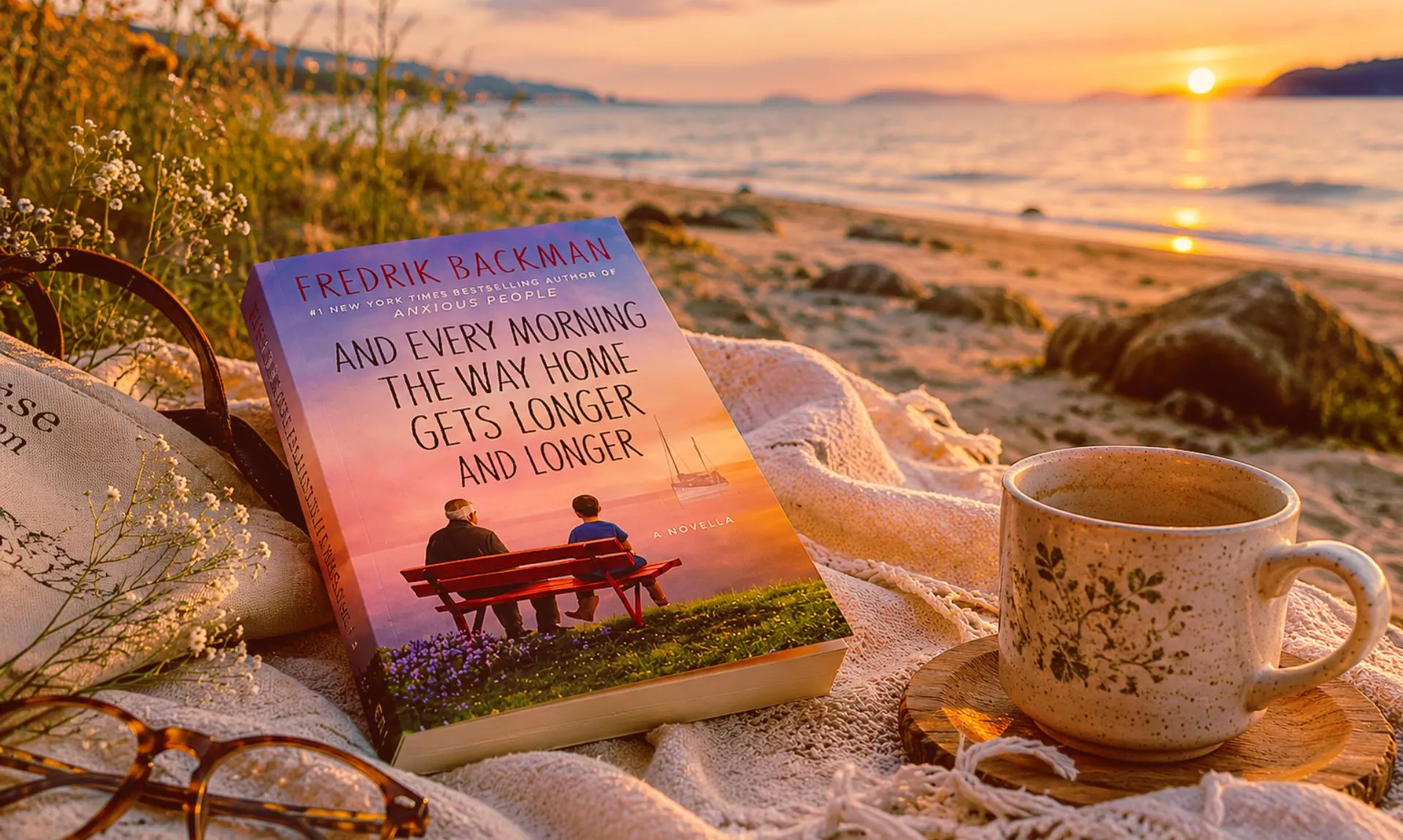
And Every Morning the Way Home Gets Longer and Longer by Fredrik Backman Honest Book Review & Summary
This post may contain affiliate links. As an Amazon Associate and Bookshop.org affiliate, I earn from qualifying purchases at no extra cost to you.
Table of Content
Book Snapshot
Title: And Every Morning the Way Home Gets Longer and Longer
Author: Fredrik Backman
Genre: Literary Fiction / Contemporary Novella
Some books about dementia focus on what is lost. Fredrik Backman’s And Every Morning the Way Home Gets Longer and Longer focuses on what remains.
Memory may be slipping away. Names may become harder to hold onto. Entire pieces of life may begin dissolving at the edges. Yet somehow, at the center of this novella, there is still love. There is still family. There is still the stubborn desire to stay connected to the people who matter most.
It’s a short book, but one that carries surprising emotional weight.
The story follows a grandfather slowly navigating dementia while spending time with his grandson Noah inside a symbolic landscape where memories blur, disappear, and occasionally return when least expected.
And while that sounds heartbreaking, and it often is, Backman approaches the subject with so much warmth and imagination that the novella never becomes overwhelmingly sad. Instead, it feels strangely comforting.
If you enjoy emotionally reflective stories about memory, love, and human connection, you might also enjoy my review of Heart the Lover, another novel that explores how people remain with us long after circumstances pull them away.
What This Story Feels Like (Before the Spoilers)
This is not really a story about dementia. At least not in the way most books approach it.
Instead of explaining the condition medically, Backman chooses to show readers what it feels like from the inside.
The result is surprisingly magical. The grandfather’s thoughts often resemble those of a child. His memories drift. Time becomes fluid. Conversations jump between different moments in his life. Reality and imagination begin to overlap.
And the more I read, the more I realized how similar childhood and old age can sometimes feel. Both are worlds where certainty becomes less important than feeling. Both depend on love and both require trust.
The Most Gentle Description of Dementia I’ve Ever Read
What impressed me most about this novella was the way Backman describes dementia.
And Every Morning the Way Home Gets Longer and Longer does not turn dementia into a frightening medical condition; the novella translates it into images readers can immediately understand. At one point, the grandfather tells his wife:
“My memories are running away from me, my love, like when you try to separate oil and water. I’m constantly reading a book with a missing page, and it’s always the most important one.” (p. 23)
That description alone captures more emotion than pages of clinical explanation ever could.
Later, when Noah asks what having the disease actually feels like, the grandfather responds:
“Like constantly searching for something in your pocket. First you lose the small things, then it’s big ones. It starts with keys and ends with people.” (p. 28)
That line stayed with me long after I finished reading. Not because it is dramatic, but because its simplicity holds the truly heartbreaking truth.
If you are into heartbreaking reads that are easy yet emotionally intense, check out my review of When Haru Was Here by Dustin Thao.
A Love Story Hidden Inside a Story About Memory
One thing I wasn’t expecting was how much I would love the relationship between the grandfather and his wife.
For such a short book, Backman somehow creates an entire love story using only fragments. At one point, Noah asks how he fell in love with her. The grandfather answers:
“She got lost in my heart, I think. Couldn’t find her way out.” (p. 33)
It’s such a Backman line. Playful. Tender. A little funny. And somehow devastating at the same time.
And Every Morning the Way Home Gets Longer and Longer constantly reminds readers that even when memories fade, emotional connections often remain. Love survives longer than details.
The Human Heart Is the Real Mystery
For a book about memory loss, And Every Morning the Way Home Gets Longer and Longer spends a surprising amount of time thinking about what it means to be human.
At one point, Backman writes:
“There is no greater mystery in the universe than a human.” (p. 19)
That idea runs through the entire novella. Not just through the grandfather, but through Noah, through the father-son relationship, and through all the small misunderstandings that families carry with them for years.
The story quietly argues that people are impossible to fully understand. And maybe that’s what makes loving them so meaningful.

A Book About Regret and Goodbyes
The older I get, the more I find myself noticing stories about regret. Backman clearly understands that feeling.
At one point, he writes:
“Almost all grown up adults walk around full of regret over a good-bye they wish they’d been able to go back and say better.” (p. 21)
That line could easily summarize the emotional heart of the novella.
Everyone in this story is trying to hold onto something: a memory, a conversation, a relationship, or a version of someone they love. While the novella primarily centers on Noah’s grandfather, Backman gives readers just enough glimpses of Noah’s father, his grandmother, and the family’s shared history to create a surprisingly complete portrait of family life.
And eventually, every one of them must confront the same difficult truth: nothing stays exactly as it was.
Children grow up. Parents grow older. Memories fade. The people we love change, and so do we. Yet the novella gently suggests that love has a way of surviving those changes, lingering long after details disappear. Perhaps that is what makes saying goodbye so difficult, and what makes holding on, even for a little while longer, so profoundly human.
If you are thinking of reading more and spending less, I have shared some reliable and legal platforms where you can find your best books at a very good deal or maybe even for FREE!
What Worked for Me
The metaphorical approach to dementia was easily my favorite aspect of And Every Morning the Way Home Gets Longer and Longer. Rather than focusing solely on what is being lost, Backman focuses on how the world gradually changes shape for the person experiencing it. The shrinking square, the drifting memories, and the dreamlike conversations create a portrayal that feels both heartbreaking and unexpectedly beautiful.
In many ways, the title itself captures this idea perfectly. As memories begin to fade, the way back to familiar people, places, and moments seems to grow longer and more uncertain. Yet even as that distance increases, the novella insists that love remains surprisingly resilient.
I also appreciated how compassionate the book is. Backman never reduces his characters to symbols or lessons about illness. They remain fully human, messy, loving, imperfect people trying to hold on to one another for as long as they can. And it is that humanity, more than the dementia itself, that gives the story its emotional power.
If you want to read something comforting and emotionally healing, check out my list of 5 comfort reads for difficult times.
What Didn’t Fully Work for Me
While I enjoyed the novella, I didn’t connect with it quite as deeply as some of Fredrik Backman’s longer works.
Part of that comes down to length. The story is intentionally brief, but there were moments when I wanted to spend more time with these characters and their relationships before the book moved on.
That said, its brevity is also part of its charm. Like memory itself, it appears, lingers for a while, and then quietly slips away.
Is And Every Morning the Way Home Gets Longer and Longer Worth Reading?
Absolutely.
Especially if you’re looking for something thoughtful, gentle, and emotionally intelligent.
This isn’t a book that tries to shock readers. It simply asks them to sit with questions about memory, aging, family, and love. And sometimes that’s more powerful.
At one point, Backman offers a small piece of encouragement:
“The only time you’ve failed is if you don’t try once more.” (p. 19)
In many ways, that spirit runs through the entire novella. Even as memories disappear. Even as time runs out. People keep reaching for one another anyway. And perhaps that’s what makes this story so memorable.
If you enjoy reflective literary fiction like this, there’s much more waiting for you on The Reader Life.