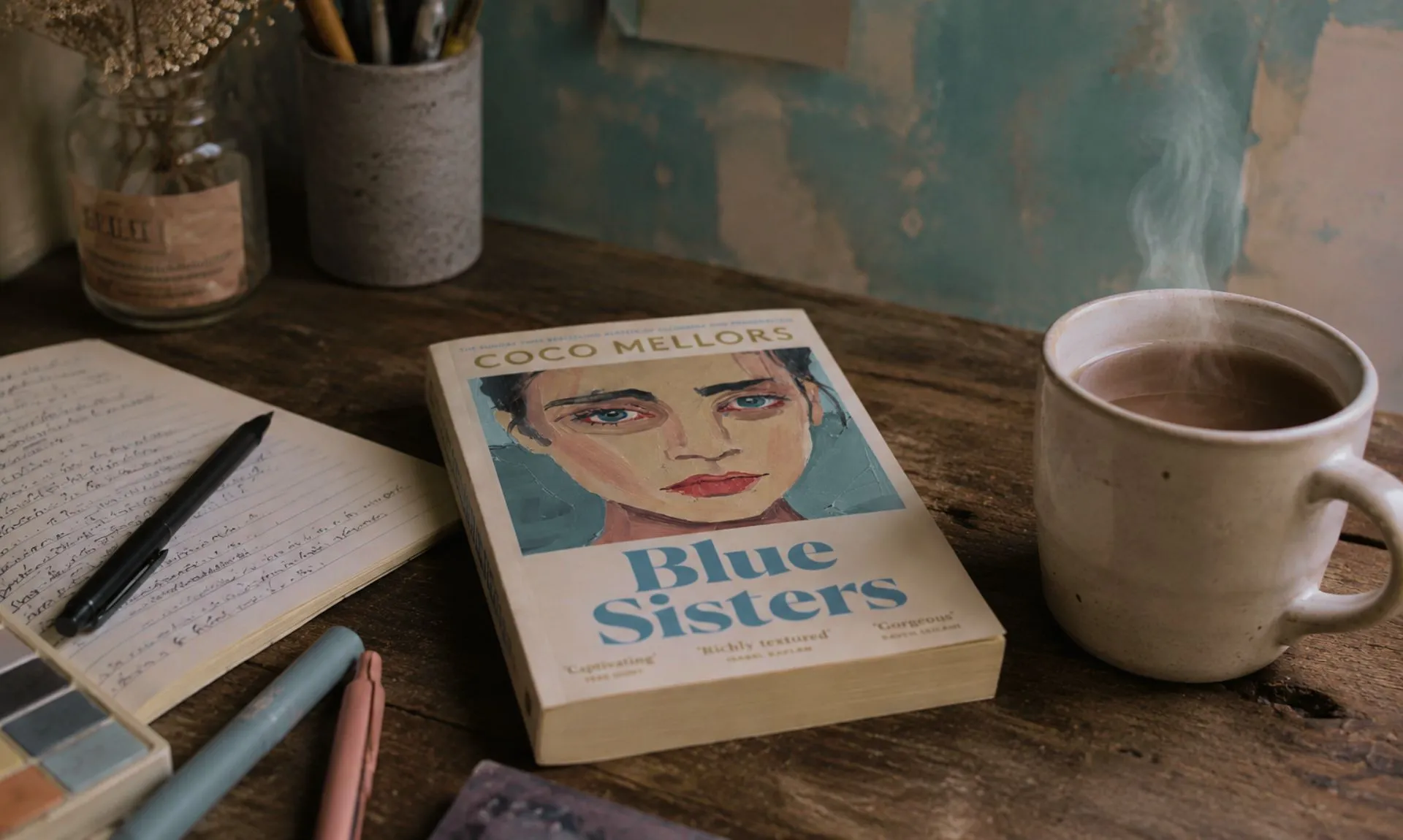
Blue Sisters by Coco Mellors — A Moving Story of Grief, Sisterhood, and Second Chances
This post may contain affiliate links. As an Amazon Associate and Bookshop.org affiliate, I earn from qualifying purchases at no extra cost to you.
Table of Content
Book Snapshot
Title: Blue Sisters
Author: Coco Mellors
Genre: Literary Fiction
“A sister is not a friend. Who can explain the urge to take a relationship as primal and complex as a sibling and reduce it to something as replaceable, as banal as a friend?” (p. 9)
Blue Sisters follows three sisters navigating the aftermath of their sister Nicky’s death, each carrying grief, guilt, and unresolved family wounds in their own way. It is told through the perspective of all three sisters and explores sisterhood, addiction, motherhood, identity, and the difficult process of learning how to live after loss.
While the pacing occasionally felt uneven and overly descriptive, Coco Mellors captures the complexity of sibling relationships with remarkable emotional honesty. This is a character-driven novel that relies less on plot and more on the intimate, often messy dynamics between sisters. Blue Sisters is tender, melancholic, and deeply human, and it stayed with me long after I finished the final page.
If you are looking for more ways to find contemporary books and read them, I have shared some of the most reliable options to Read Contemporary Fiction For Free
What Is Blue Sisters About?
The novel follows four sisters: Avery, Bonnie, Nicky, and Lucky.
Though Nicky or Nicole is already dead when the story begins, her death from an overdose connected to chronic pain becomes the emotional center around which the rest of the novel moves.
One year after her death, the sisters reunite in New York after learning their mother plans to sell their home apartment where Nicky lived her entire life. What follows is less about external plot and more about emotional excavation. Through alternating perspectives, we slowly see how each sister carries grief differently and how guilt, trauma, and family history continue shaping their lives long after loss.
The narrative unfolds through multiple POVs, and this structure works beautifully because every sister feels emotionally distinct.
The Portrayal of Sisterhood Feels Painfully Real
“You don’t choose each other, and there’s no furtive period of getting to know the other. You’re part of each other, right from the start.” (p. 9)
This quote honestly captures the entire emotional atmosphere of the novel. There is something uniquely intense about sibling relationships because they exist before identity itself. Your siblings know you before adulthood, before reinvention, before performance. They know the versions of you that nobody else does. Blue Sisters understands that completely.
The sisters love each other deeply, but that love is tangled with resentment, obligation, protectiveness, anger, guilt, and years of unresolved hurt. Their arguments became some of my favourite scenes in the novel because they felt so emotionally authentic. Mellors never romanticizes sisterhood into something soft or uncomplicated. Instead, she portrays it as messy, exhausting, and deeply rooted in shared memory.
The novel also beautifully captures how fractured families often become most emotionally vulnerable during the beginnings and endings of their meetings:
“It was easy to love someone in the beginnings and endings; it was all the time in between that was so hard.” (p. 100)
This idea of loving someone during the beginnings and endings highlights the essential human nature; it is easier for us to be nice or loving to each other when we have just met, or we are about to say goodbye.
Every Sister Experiences Grief Differently
One of the strongest aspects of the novel is how differently each Blue sister processes grief.
Avery, the eldest, carries an overwhelming sense of responsibility toward everyone around her. She has spent most of her life acting almost like a second mother to her sisters, and that emotional burden follows her into adulthood, affecting her marriage, identity, and understanding of motherhood itself.
Bonnie feels emotionally restrained in a completely different way. Her relationship with Pavel introduces one of the quieter romantic arcs in the novel, but even that relationship is shaped by grief and emotional hesitation. The romance in Blue Sisters remains subtle throughout, never overpowering the novel’s central themes.
Lucky, however, was probably the hardest character for me to read because she feels so completely untethered from herself. Unlike her sisters, she has no stable emotional support system to hold onto, and her chapters portray grief in its most self-destructive form.
At one point, Lucky reflects:
“She wanted to find a trapdoor in her mind and disappear down it, to the place where memories couldn’t reach her anymore.” (p. 28)
And later:
“She’d heard once that guilt was for something you’d done — you could feel guilty for a certain behavior or action but still fundamentally know you were a good person — but shame was deeper, shame was for who you were.” (p. 279)
Mellors portrays trauma with remarkable emotional precision. Grief in this novel is repetitive, cyclical, and impossible to escape:
“Her mind darted through the same closed circuit of memories, as a bee trapped indoors will pound again and again at the same windowpane, looking for escape.” (p. 282)
And even Nicky, despite being absent physically, remains emotionally alive throughout the narrative. Every sister carries her differently.

Addiction, Pain, and Emotional Survival
One thing I really appreciated about the novel was how it handled addiction and emotional pain with compassion rather than judgment.
Nicky’s overdose is connected to her struggle with chronic pain caused by endometriosis, and the novel repeatedly asks difficult questions about suffering, relief, and self-destruction.
One of the most poignant lines in the novel comes during Avery’s conversation with Charlie:
“Weren’t all addicts looking for relief from some invisible pain? Weren’t all people?” (p. 144)
That line honestly summarizes one of the novel’s biggest emotional truths: everyone in this story is trying to survive something.
Whether through addiction, emotional withdrawal, ambition, love, anger, or avoidance, each sister is attempting to cope with pain in the only way she knows how.
If you enjoy reading about pain and emotional survival in the modern context, I have recently reviewed Heart the Lover by Lily King, which is also an amazing book.
Patriarchy, Parenthood, and Emotional Inheritance
Family dynamics are one of the novel’s greatest strengths.
The sisters’ father is portrayed with surprising complexity. He is not reduced into a one-dimensional villain, but his alcoholism and emotional instability shape the household in devastating ways.
“He was the only man in the house, but he also was the house. They lived inside his moods.” (p. 27)
That sentence alone says so much about patriarchy and emotional dominance within dysfunctional homes.
Motherhood is also explored beautifully throughout the novel, particularly through Avery’s perspective. Avery has essentially spent her life raising her younger sisters, and because of that, motherhood feels less like an idealized dream and more like emotional exhaustion.
Her relationship with her mother is equally complicated:
“She wished she would just be a good mother or a bad one; this vacillating in between was unbearable.” (p. 333)
And yet some of the novel’s most tender moments emerge near the end during the conversations between Avery and her mother:
“I didn’t know how hard it would be. Becoming a mother is a shocking thing, Avery. Like landing on the moon. Everything changes.” (p. 343)
The novel treats motherhood not simply as a role, but as a feeling; something heavy, transformative, and often all-consuming.
The Pacing Was Uneven but Emotionally Rewarding
My biggest issue with Blue Sisters was definitely the pacing.
This was one of those books where my rating kept fluctuating between three and four stars while reading. Some sections were emotionally gripping and beautifully written, while others became overly descriptive and noticeably slow. There were moments where I felt completely immersed in the sisters’ emotional lives, and other moments where the narrative intensity suddenly disappeared.
Still, the emotional payoff ended up working for me. Especially in the second-last chapter. That section completely reframed the novel emotionally and added a tenderness that made many earlier scenes resonate more deeply in retrospect.
If you are more into fast-paced stories, I would totally recommend checking out this list of 5 thrillers that will keep you hooked.

The Ending Changed My Entire Experience of the Novel
“Once you get to my age, you will learn that you can take a lot of wrong turns and still end up in the right place.” (p. 347)
This quote honestly feels like the emotional conclusion of the novel itself.
By the end, Blue Sisters becomes less about grief alone and more about giving yourself permission to continue living despite grief. Every sister feels responsible for Nicky’s death in some way, but the novel slowly guides them toward forgiveness, acceptance, and second chances.
The epilogue especially worked for me because it felt emotionally satisfying without forcing unrealistic closure onto the characters. It gives readers a little bit of everything: sadness, warmth, distance, hope, and healing.
And despite all its heaviness, the novel ultimately left me with an unexpected feeling of comfort. A tender, melancholic feeling of coming home, to something that has changed beyond recognition, and still finding value in returning to it anyway. It is complicated, I know, but you will be able to fully relate to it if you read the book.
If you enjoy reading books that tell the emotionally heavy stories of unforgettable characters and still manage to heal something inside you, check out my list of 5 books everyone should read in their 30s.
Wrapping Up!
Blue Sisters is not a perfect novel. The pacing occasionally drags, certain sections feel overly descriptive, and there were moments where I found myself fluctuating between a three-star and four-star rating while reading.
But despite all of that, this book stayed with me.
What makes Blue Sisters so compelling is not its plot, but the emotional honesty of its characters. Coco Mellors understands grief in all its messy and contradictory forms: guilt, anger, shame, love, exhaustion, and the quiet desire to keep living even when loss changes everything.
Every sister carries pain differently. Avery tries to hold everyone together while quietly falling apart herself. Bonnie buries emotion beneath restraint and routine. Lucky spirals through grief with nowhere stable to land. And even Nicky, despite her absence, remains emotionally present throughout the narrative.
The novel ultimately becomes less about death and more about survival, about giving yourself another chance, about accepting that people can break apart, take wrong turns, hurt each other deeply, and still find a way forward.
If you enjoy character-driven literary fiction that explores family dynamics, addiction, motherhood, grief, and emotional survival with tenderness and realism, Blue Sisters is absolutely worth reading. The book is also available on Audible, where you can listen to it for free if you sign up for the free trial.
And if you’re someone who loves emotionally reflective contemporary fiction, you’ll probably find parts of yourself hidden somewhere inside these sisters, too.
Enjoyed the review? There’s a lot more waiting for you on The Reader Life.