
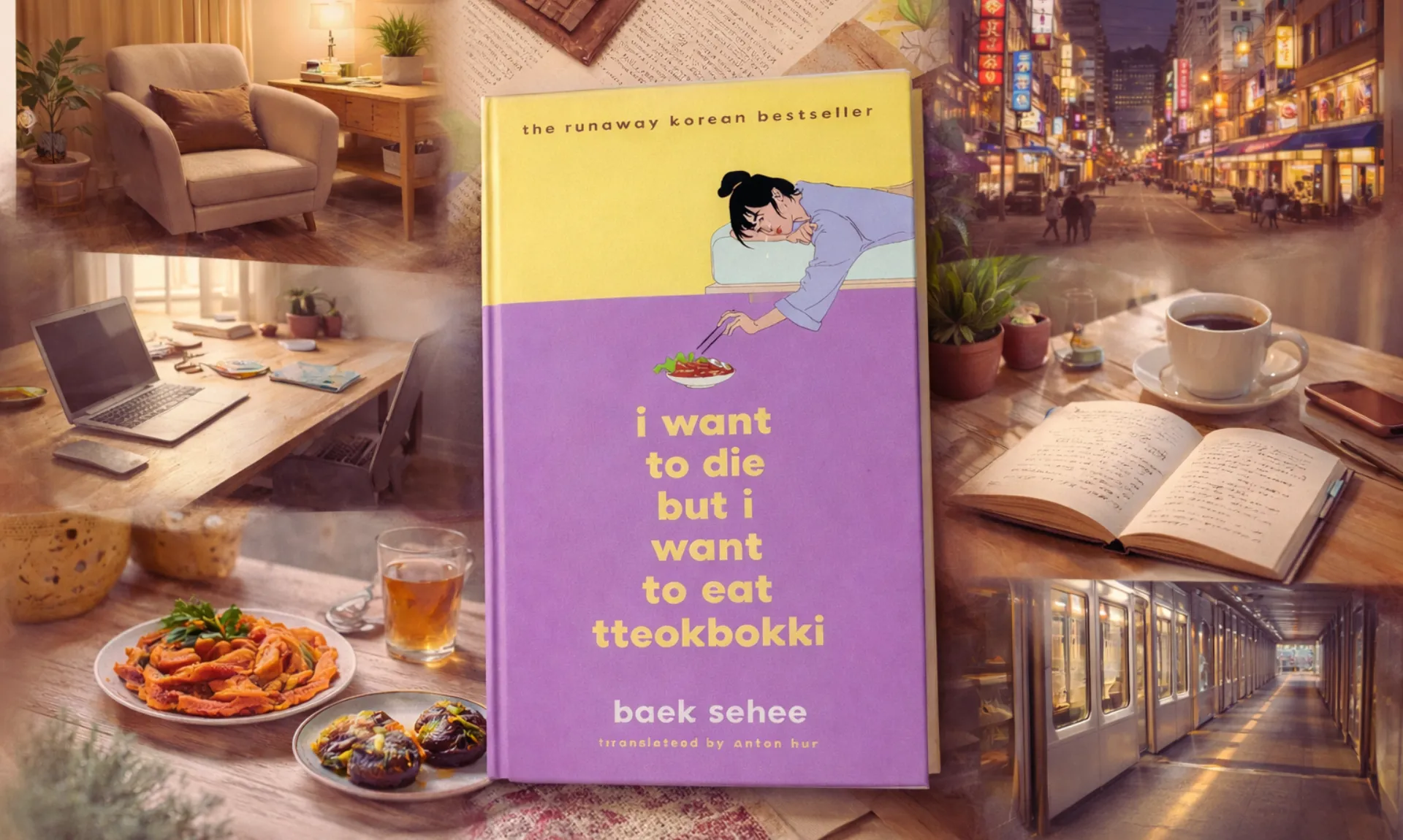
I Want to Die but I Want to Eat Tteokbokki by Baek Sehee Honest Book Review
Table of Content
- Book Snapshot
- What It’s All About!
- Let’s Talk Storytelling
- Favorite Characters (If That Even Applies Here)
- Themes, Feels & Food for Thought
- Favorite Lines from I Want to Die but I Want to Eat Tteokbokki
- What Worked for Me
- What Didn’t Work for Me
- Final Thoughts
- FAQs About I Want to Die but I Want to Eat Tteokbokki
Book Snapshot
Title: I Want to Die but I Want to Eat Tteokbokki
Author: Baek Sehee
Translator: Anton Hur
Genre: Memoir / Mental Health / Reflective Nonfiction
I Want to Die but I Want to Eat Tteokbokki is a memoir, it is a book about living with a quiet kind of sadness, the kind that doesn’t look dramatic from the outside but stays with you every single day.
Baek Sehee records her therapy sessions as she tries to understand why she feels stuck, emotionally distant, and constantly unsure of herself despite having what looks like a perfectly normal life.
It’s gentle. It’s reflective. It’s very easy to read.
And honestly? It’s also a little overrated.
The title pulled me in immediately (like it did for most readers on BookTok), and I really wanted to love this one. I respected what the author was trying to do. But as a reading experience, it didn’t fully work for me.
Still, I can absolutely see why so many people connected with it.
If you’re new to reading or looking for something emotionally accessible, you might even enjoy starting here, especially alongside lists like my guide to 5 Beginner-Friendly Books That Will Instantly Hook You Into Reading.
What It’s All About!
The book follows Baek Sehee’s real-life therapy conversations with her psychiatrist after she is diagnosed with dysthymia which is a long-lasting, low-level depression that often hides behind a “functioning” daily life.
Instead of a traditional memoir with a clear narrative arc, the book moves through short therapy transcripts where she talks about:
- feeling emotionally flat
- needing constant reassurance
- struggling with relationships
- worrying how others perceive her
- feeling tired without knowing why
- and blaming herself even when nothing is clearly wrong
The central idea is simple but powerful:
you can look completely fine and still feel quietly miserable inside.
And sometimes that feeling stays longer than expected.
Let’s Talk Storytelling
Before anything else, I genuinely respect this book for existing.
It takes courage to document therapy sessions and publish them for the world to read.
But from a reader’s perspective, the storytelling felt repetitive and emotionally distant at times.
At first, I actually assumed this might be a translation issue. Some books lose their rhythm when they move between languages. But knowing Anton Hur also translated Cursed Bunny (which I absolutely loved) made it clear the problem wasn’t the translation.
It was the structure and narrative.
The conversations between the author and the psychiatrist often circle the same emotional ground again and again without developing into deeper insight. Instead of unfolding like a memoir, the book sometimes feels like reading carefully selected journal entries that do not convey the full thought process.
Interestingly, the strongest part of the book comes near the end, when both the psychiatrist’s observations and the author’s reflections begin to feel more direct and thoughtful.

Favorite Characters (If That Even Applies Here)
I Want To Die But I Want To Eat Tteokbokki is built around therapy conversations, so the readers mostly meet either the author or her psychiatrist. We don’t really get traditional “characters.”
We hear about:
- her mother
- coworkers
- friends
- past relationships
but only briefly.
I kept wishing this memoir explored these relationships more deeply because mental health stories often become more powerful when we see how people around the narrator respond or behave. It does make sense considering that the author’s main point is to present therapy sessions before the reader, but it still felt a bit limiting to me as a reader. Just think, there could have been something more done with the book and the title.
Themes, Feels & Food for Thought
The strongest theme in I Want to Die but I Want to Eat Tteokbokki is that depression doesn’t always look like what we expect it to look like.
Sehee shows that depression is sometimes quiet. Sometimes it’s confusing. Sometimes it doesn’t even feel serious enough to explain to other people.
One line that really stayed with me was:
“Classic signs such as hearing voices, intrusive thoughts and self-harming aren’t the only signs of depression. Just as a light flu can make our whole body hurt, a light depression can make our minds ache all over.” (p. 9)
That idea alone explains why this book resonates with so many readers.
Another moment that stood out:
“When you’re having a hard time, it’s natural to feel like you’re having the hardest time in the world. And it’s not selfish to feel that way. Just because certain conditions in your life are relatively better, it doesn’t mean you’re better off in general.” (p. 27)
There’s something comforting about being reminded that your struggles don’t have to be dramatic to be real.
And maybe the most hopeful line in the book:
“If twenty-year-old me met me today, she would cry with joy. And that’s enough for me.” (p. 42)
Sometimes healing looks exactly like that.
Favorite Lines from I Want to Die but I Want to Eat Tteokbokki
This is one of those books that works best in fragments.
Some lines quietly stay with you even after the reading experience fades.
Here are a few that stood out to me:
“To right every wrong you come across in the world would be an impossible endeavour for any one person. You’re just one person, and you’re putting too much weight of the world on yourself.” (p. 15)
“If I’m sad today I’ll be happy tomorrow, and if I’m happy today I’ll be sad tomorrow – that’s fine. As long as I keep loving myself.” (p. 62)
“Life is as messy as a bag whose owner never cleans it out. You have no idea when you might reach in and pull out a piece of old trash, and you’re afraid someone is going to look through your bag someday.” (p. 136)
And of course:
“Because the human heart, even when it wants to die, quite often wants at the same time to eat some tteokbokki, too.”
That line alone explains why the book became so widely shared online.
What Worked for Me
Even though I had mixed feelings overall, a few things genuinely stood out.
First of all, Baek Sehee’s memoir is extremely readable. The short chapters and simple language make it approachable even if you don’t usually read memoirs or mental health books. If you want to know more about mental health, here is the list of books that explore such topics: 5 Heartbreaking Young Adult Novels That Truly Understand Teenage Life
Second, it quietly works like a soft self-help book, but without sounding like one. Instead of giving advice, it gives recognition. And sometimes that’s exactly what readers need.
Third, the ending reflections were noticeably stronger than the earlier therapy conversations. That section finally felt more personal and grounded.
What Didn’t Work for Me
The repetition was the biggest issue for me.
Many conversations circle the same emotional ideas without adding new layers, which made the book feel slower than expected despite being so short.
I also struggled with how little we learn about the people around the author, especially her mother. Those glimpses felt important, and I kept wanting the book to stay there longer.
At times, even the psychiatrist’s responses felt strangely diagnostic instead of exploratory, which created distance rather than clarity.
And emotionally, I’ll be honest, I often felt more frustrated than moved.
The tone sometimes felt controlled where I expected openness, almost like the book was carefully arranged instead of naturally unfolding.
That doesn’t mean it won’t work for everyone.
It just didn’t fully work for me.
Final Thoughts
I completely understand why I Want to Die but I Want to Eat Tteokbokki by Baek Sehee became so popular. It’s gentle, approachable, and very relatable for readers experiencing quiet emotional exhaustion rather than intense depression. It’s also a strong starting point if you’re new to mental health memoirs or reflective nonfiction.
It’s not perfect, but it is important, especially for readers who feel low without knowing exactly why.
I’d particularly recommend it to younger readers who are trying to understand subtle anxiety, emotional numbness, or that strange feeling of being “fine but not really fine.” The therapy-focused structure might feel like a catharsis, who knows!
If you enjoy soft, introspective books that help you understand yourself a little better without overwhelming you, this one is still worth trying.
And if you’re exploring reflective reads like this, but have no idea where to get them, you might want to check my curated guide to 10 Best Book Reading Websites Every Reader Should Bookmark.
There are plenty more honest and thoughtful book reviews waiting for you on The Reader Life. Dive in, you might just discover your next favorite read. 📚✨